
Most Alberta boat owners follow a similar winterizing sequence: flush the engine, fog the cylinders, drain the water systems, cover or shrink-wrap the hull, put the trailer on stands. The vinyl wrap, if the boat has one, usually gets a cursory inspection at best, or no attention at all.
That oversight is expensive. A boat wrap that goes into winter storage with unaddressed edge lifting, mineral deposits concentrated at the waterline, or micro-damage from a summer of UV and water exposure comes out in May with problems that are significantly harder and more costly to address than they would have been in September. The freeze-thaw cycling that Alberta winters apply to everything acts on any compromised vinyl edge like a slow, persistent prying tool.
An afternoon of inspection, cleaning, and correct storage preparation before the boat goes under cover pays back many times over in wrap condition come spring. This guide covers the sequence: what to clean, what to inspect, what to repair before storage, and how to set up storage conditions that protect the wrap through winter.
Why End-of-Season Wrap Inspection Matters
Vinyl wrap is a durable product when properly installed and maintained, but it is not immune to the cumulative effects of a full Alberta boating season. From ice-out in late April through the end of September, a boat wrap in regular use is exposed to UV radiation, repeated water immersion, the minerals and tannins in Alberta lake and river water, wake turbulence that flexes hull panels, fuel contact during fill-ups, and the physical contact of lines, fenders, and dock hardware.
Most of these stresses are absorbed without visible damage. But some leave traces: minor edge lifting at the bow where water contact is constant, waterline mineral deposits that harden into a white ring if not removed, small scratches in the laminate from debris contact, and the beginning of UV degradation on the horizontal surfaces of the deck area that receive direct overhead sun throughout the season.
The reason to address these in September rather than May is simple: winter amplifies them. A 5-millimetre lifted edge at the bow in September is a 40-millimetre lifted section by April, because freeze-thaw cycling has worked under the edge repeatedly. A mineral deposit ring at the waterline that wipes off easily in October requires significant effort or professional cleaning by May after months of hardening. Finding and addressing these issues before storage is the lowest-cost version of every repair the wrap might need.
Cleaning the Wrap Before Storage: The Correct Sequence
The pre-storage cleaning serves two purposes: it removes contaminants that cause ongoing damage during storage, and it gives you a clean surface on which to do the inspection. Attempting to inspect a dirty wrap misses surface damage hidden under waterline deposits and road film.
Step one is a thorough freshwater rinse to remove lake minerals, road dust from trailering, and any residual fuel or oil film. Use a garden hose at normal pressure, not a pressure washer at the hull seams. Work from top to bottom: hull topsides first, then the waterline band, then below if the wrap extends below the waterline. Allow the rinse to dwell briefly on the waterline area where mineral deposits concentrate.
Step two is a pH-neutral soap wash using a soft microfiber mitt. The same principles from automotive wrap care apply on the water: no ammonia, no abrasives, no high-pressure at seams. For the waterline area specifically, a diluted white vinegar solution (one part vinegar to ten parts water) applied with a soft cloth after the soap wash effectively loosens mineral buildup without attacking the vinyl. Rinse thoroughly after the vinegar application.
Stubborn stains should be addressed individually with the appropriate spot treatment. Isopropyl alcohol at 50% concentration works well for most organic stains on vinyl without damaging the laminate. Bird droppings should be soaked and blotted rather than wiped, as the acid in bird waste etches vinyl laminates and dry wiping spreads the acid. Rinse each spot-treatment area thoroughly after treatment.
Dry the wrap thoroughly before storage. Storing a wet wrap under a cover encourages mildew growth on the vinyl surface and softens adhesive over prolonged contact with moisture. Allow the hull to air dry completely, or use clean microfiber towels on accessible areas. A final wipe with a vinyl-specific UV protectant spray adds a layer of UV and moisture protection through the storage period.
Inspecting the Wrap: What to Look For
With the wrap clean and dry, the inspection covers the following areas systematically.
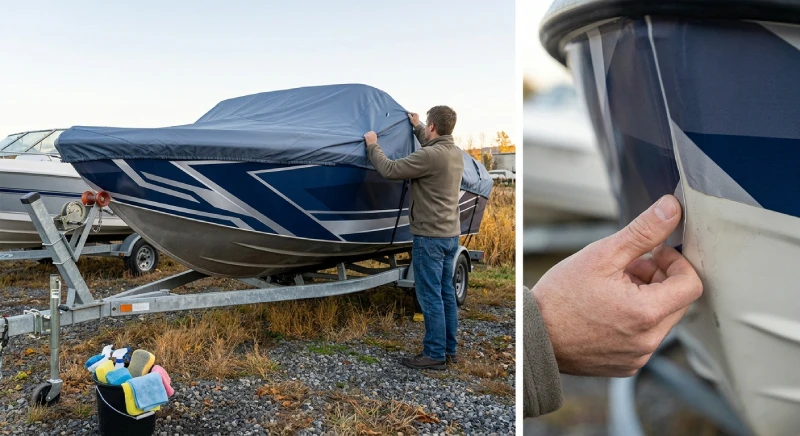
Edges and seams are the highest priority. Run your fingertip along every edge where vinyl meets an unvraped surface: the bow, the stern, the waterline edge, any panel seams in the design, and any cutouts around hardware, vents, or fittings. Any section where the vinyl has lifted more than a few millimetres is a repair item. Early-stage lifting can be resealed by a wrap installer with heat and edge adhesive in minutes. Late-stage lifting that extends 30 or more centimetres inward from the edge typically requires section replacement.
Bubbles between the vinyl and the hull surface indicate moisture intrusion or adhesive failure beneath the graphic. Small bubbles (under 10 millimetres) that are isolated and do not compress when pressed may be air pockets from the installation that have remained stable. Monitor these, but they may not require action. Larger bubbles, or bubbles in areas where there was no previous bubble, typically indicate that moisture has worked under the vinyl through a nearby lifted edge. Address the source of entry before addressing the bubble.
Horizontal surfaces receive the most UV exposure during the season and should be checked for signs of laminate degradation. A healthy laminate surface has a consistent sheen (gloss, matte, or satin depending on the wrap specification). A surface that shows localized clouding, chalking, or a change in texture compared to surrounding areas may indicate laminate breakdown beginning. Caught at this stage, the affected area can sometimes be addressed with vinyl protectant; advanced laminate failure typically requires section replacement.
Protecting Boat Wraps in Winter Storage
The ideal winter storage for a wrapped boat is covered, indoor, climate-controlled, eliminating UV year-round, preventing freeze-thaw cycling on the hull, and maintaining a stable temperature range that is easy on adhesives. If your storage situation allows for this, it is the single most effective preservation measure available.
For boats stored outdoors under shrink wrap, the vinyl wrap is protected from direct UV but still experiences the freeze-thaw cycling that Alberta winters bring. The critical requirement when shrink wrapping over a vinyl-wrapped hull is to ensure the shrink wrap does not contact the vinyl directly. Shrink wrap that is tight against a vinyl graphic surface can bond to the laminate over winter, and when the shrink wrap is cut in spring, sections of the laminate can peel with it. Use frame supports or standoffs to create a clearance between the shrink wrap and the hull graphic.
Canvas and tarpaulin covers are acceptable if they breathe. A moisture-trapping cover that holds condensation against the hull surface is worse than no cover at all, because the sustained moisture contact softens adhesive and promotes mildew. If your cover does not breathe, leave some ventilation gaps at the lower edge to allow moisture to escape.
Before the boat goes into storage, press any slightly lifted edges firmly back against the hull surface and apply heat with a hair dryer or low-heat heat gun to reactivate the adhesive. This simple step prevents those lifted sections from becoming fully separated over winter. Edge sealant from a wrap-specific product line provides additional holding power at vulnerable edges.
Marine Vinyl Care Through the Season: Habits That Extend Wrap Life
Pre-storage care is easier when the season’s habits have been good. A few practices that make a meaningful difference in how a boat wrap weathers an Alberta boating season:
Rinse with fresh water after every time on the water. Alberta lakes and rivers have varying mineral content, and mineral deposits that are rinsed off the same day wash away cleanly. Deposits that are allowed to dry and then dry again over multiple outings build up progressively harder mineral films that require increasing effort to remove. A post-launch rinse takes five minutes and prevents most of the waterline deposit accumulation that is the most labor-intensive part of pre-storage cleaning.
Keep fuel away from the vinyl surface during fill-up. Gasoline softens vinyl adhesive on contact and degrades the film if it soaks in. Draping a cloth over the deck area around the fuel fill before opening the cap is a simple habit that prevents fuel spill contact. Wipe any contact immediately rather than allowing it to evaporate.
Apply a UV-protectant spray formulated for marine vinyl at the beginning of the season and again at mid-season. These products provide a protective barrier against UV radiation, water mineral deposits, and light contamination without the residue problems of wax. They are the marine equivalent of the vinyl sealant recommended for vehicle wraps, and they work on the same principle: a sacrificial protective layer that can be renewed at each application rather than allowing UV to degrade the laminate directly.
FAQ
- Should I wax or polish a boat wrap? – Vinyl boat wraps should not be waxed with traditional marine or automotive wax. Wax fills the surface texture and interferes with the laminate, particularly on matte and satin finishes, creating a blotchy, uneven appearance. The correct product is a UV-protective spray sealant specifically formulated for vinyl wraps. It provides UV protection and water beading without wax residue. Apply it after the final pre-storage cleaning and again at the beginning of each season.
- How do I remove mineral deposits from a boat wrap? – Mineral deposits from hard Alberta lake and river water appear as white or chalky residue, concentrated at the waterline. Rinse first with fresh water while deposits are still soft from recent contact. For hardened deposits, a diluted white vinegar solution (one part vinegar to ten parts water) applied with a soft cloth and allowed to dwell for a minute or two loosens mineral buildup without damaging the vinyl. Do not use abrasive cleaners or scrub pads, which scratch the laminate surface.
- Can a boat wrap be repaired if edges start lifting? – Yes, in most cases. A lifting edge or seam caught early can be repaired by a wrap installer using heat reactivation and edge adhesive in a few minutes at low cost. Lifting that has extended over a large panel section may require panel replacement. The best time to address lifting is before winter storage, when the problem is small, rather than after winter has worked under the edge and made it a larger repair.
- Does a boat wrap protect the hull underneath? – A vinyl boat wrap provides UV protection and minor abrasion resistance to the hull surface beneath it. It protects factory paint from UV oxidation and direct sun degradation, a significant source of hull finish deterioration over time. The wrap does not protect against impact damage or deep scratching, and is not a structural protective coating. When the wrap is eventually removed, the hull paint underneath is typically in noticeably better condition than it would have been with direct UV exposure.
- How long does a boat wrap last in Alberta? – A professionally installed boat wrap using marine-grade vinyl typically lasts four to six years in Alberta conditions with proper care. Boats stored outdoors year-round without covers at the UV-intense end of the spectrum see faster degradation on horizontal surfaces. Boats stored indoors during winter and maintained with UV protectant through the season consistently reach or exceed the upper end of this range. The waterline area is typically the first to show wear due to constant water immersion and mineral exposure.