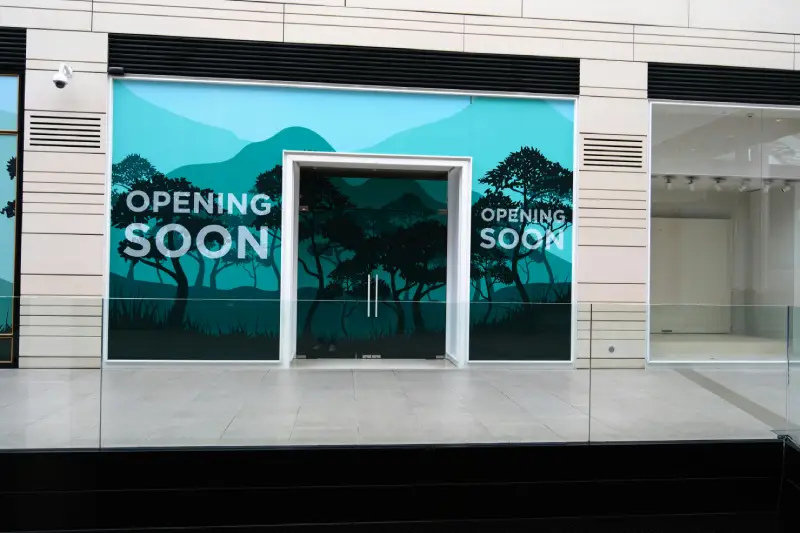
Storefront windows face the street, the parking lot, and foot traffic all day. Most businesses use them for nothing more than an hour decal and maybe a seasonal paper sign taped from the inside.
The hesitation makes sense: covering windows feels like closing off the space. A solid vinyl banner blocks natural light, makes the interior look dark from outside, and puts a wall between the business and the street. See-through window graphics fix this. Using perforated vinyl, you get a full-coverage printed image on the outside of the glass while maintaining a near-normal view from inside. It’s one of the more widely misunderstood products in commercial signage, and the confusion usually comes from people who’ve seen the product but don’t know how it works.
What Are See-Through Window Graphics?
See-through window graphics, also called one-way vision film, perforated window film, or micro-perf vinyl, are printed on a vinyl sheet with thousands of small circular holes punched through it. From outside, the solid printed surface between the holes displays your graphic. From inside, light and vision pass through the holes, so you can see out without obstruction. The result is a full image on the exterior with roughly 50 percent optical transparency from the interior.
The technology has been standard in transit advertising for decades. Bus and train windows with full advertising graphics that passengers can still see through are built on the same principle. The storefront application works the same way.
One thing to know before installation: the see-through effect depends on daylight. During the day, ambient light outside is brighter than interior lighting, so the graphic reads clearly on the outside while your view out is maintained. After dark, when interior lighting is brighter than the exterior, this inverts. The graphic becomes partially visible from inside, and the exterior branding effect is reduced. This is called the night-reversal phenomenon. It’s a normal characteristic of the material, not a defect.
How Perforated Window Film Works
The key spec is the perforation ratio. The most common is 50/50: 50 percent solid printed vinyl, 50 percent open holes. That ratio determines the balance between graphic quality from outside and visibility from inside.
A 50/50 film produces a bright, high-contrast printed image on the exterior. At normal viewing distances, the holes are invisible, and the graphic looks solid. From inside, you get approximately 40 to 50 percent light transmission, similar to looking through a screen window: readable and functional, not as clear as bare glass.
Higher-opacity films like 60/40 produce a bolder exterior graphic with less interior transparency. Lower-opacity options at 40/60 or 30/70 pass more light but reduce graphic impact. For most storefront applications, 50/50 is the right call. Backing color matters too: white-backed film gives the most accurate color rendition on the exterior, which counts when specific color matching is involved. Black-backed film cuts light transmission more aggressively and is more common when privacy is the primary goal.
One-Way Window Graphics: Storefronts and Offices
Retail storefront advertising
Seasonal graphics on a retail storefront are one of the cleaner applications for perforated window film. A full-window graphic promoting a seasonal collection, a sale, or a product launch gives you billboard-scale coverage at the size of your largest storefront surface, and the glass underneath comes out clean when you pull the film. Retailers who rotate graphics seasonally maintain a fresh exterior that passing traffic notices. A store that looks the same every week for years becomes invisible to people who walk by regularly.
Office privacy screening
Ground-floor offices, boardrooms with glass walls, medical reception areas, and financial advisory offices all face the same problem: they need privacy from the street or corridor without creating a closed environment. A common approach is perforated film on the bottom half of the window, keeping a clear upper section for light while the lower section provides screening at seated eye level. The film can be neutral, a gradient fade, or a branded graphic. From outside, the firm’s branding is clearly visible. From inside, you get a slightly filtered view of the street below.
This is common in St. Albert and Edmonton medical and dental corridors, where patient privacy at reception is a practical concern and full frosting tends to make the exterior look uninviting.
Vehicle rear window graphics
The same perforated vinyl applies to vehicle rear windows. A full-coverage rear window graphic on a cargo van or pickup truck displays at full size while maintaining rear visibility for the driver. It’s one of the few ways to extend a full vehicle wrap onto the rear glass without creating a safety problem, and it adds meaningful printable surface area. Rear window graphics are included in most full wrap packages and can be added to partial wraps as a standalone upgrade.
Storefront Window Privacy: Balancing Openness and Discretion
Not every business needs advertising on its windows. Some just need privacy. The right solution depends on where your business falls on the spectrum, and different parts of the same window may need different treatments.
Restaurants showing a lively interior, gyms with equipment visible, studios communicating activity: these businesses benefit from maximum transparency. Perforated film with a lower-opacity ratio on specific panels, or frosted bands at the base of windows, is usually enough.
Counselling offices, financial advisors, medical clinics, legal firms: these need more coverage. Frosted or etched-look window film gives a sandblasted appearance that communicates discretion without looking like the windows have been papered over. Full opaque frosting on lower sections with a clear upper band is a common compromise, providing ground-level privacy while the upper window keeps passing light.
Perforated window film sits between these two options. It provides exterior branding and privacy while keeping more interior light transmission than frosted film. For businesses that need both advertising and discretion, it’s often the most practical single product.
Installation and Durability
Perforated window film can be applied to the exterior or interior surface of the glass. Exterior application produces a sharper, higher-contrast graphic from outside and is standard for maximum visual impact. Interior application is easier to install and replace, produces a slightly softer exterior appearance (the graphic is viewed through the glass), and is more common for temporary or frequently changed applications.
For exterior applications in Alberta’s climate, UV-laminated perforated vinyl is not optional. UV coating protects the ink from significant summer UV radiation. Uncoated materials can fade within a single season. Quality exterior-grade perforated film with UV laminate is rated for three to five years of outdoor exposure. Interior applications last longer because they’re protected from the weather entirely.
Cold weather introduces a specific installation consideration. Vinyl adhesives become less flexible below 5°C, which can result in poor adhesion, edge lifting, or difficulty conforming the film to the glass surface. Most sign companies schedule exterior window film installations for spring through fall, or use climate-controlled methods for winter work.
On cleaning: standard ammonia-based glass cleaners like Windex degrade vinyl adhesives over time. Water with a small amount of dish soap, applied with a soft cloth or squeegee, is the correct method. Worth knowing before the first cleaning after installation.
Design Considerations for High-Impact See-Through Graphics
The perforation structure affects how design elements render at a distance. Fine text, hairline borders, and detailed line art lose definition because the holes interrupt the solid printed areas. For graphics read from more than six to eight feet away, text should be at a minimum of two to three inches of cap height, with bold or heavy weight typefaces preferred over light or thin styles.
High-contrast imagery works best: a bold logo on a solid background, a high-contrast product photograph, simple typographic treatments. Gradient-heavy images and fine photographic detail read reasonably well up close but simplify at a distance. Design for how the graphic looks from the sidewalk, not for someone standing with their face at the glass.
Night-reversal is worth thinking through at the design stage. A lighter background shows more of it, since interior light passing through the holes makes the graphic appear to glow from inside. A dark background shows less. Some businesses use this effect deliberately. Most just want to confirm the graphic reads acceptably in both conditions before approving the file.
FAQ
Q1: What are see-through window graphics made of?
See-through window graphics are printed on perforated vinyl film, a thin adhesive vinyl sheet with thousands of small holes punched through it. The holes allow light and vision to pass through from inside, while the solid printed surface between the holes displays your graphic to people outside. The most common perforation ratio is 50/50: half the surface is printed, half is open.
Q2: Can you see through perforated window film from inside?
Yes, during daylight hours. The view is slightly reduced, similar to looking through a screen window, but functional. At night, when interior lighting is brighter than the exterior, the effect reverses, and the graphic becomes partially visible from inside. This night-reversal effect is a normal characteristic of perforated film, not a defect.
Q3: How long do one-way window graphics last on a storefront?
High-quality UV-laminated perforated vinyl applied to the exterior of a window typically lasts three to five years before the print or adhesive degrades noticeably. Interior-applied graphics last longer because they’re protected from weather. In Alberta, UV exposure during summer months is significant, making UV laminate essential for any exterior application expected to last more than one season.
Q4: Do window graphics need a permit in Alberta?
In most Alberta municipalities, window graphics that are part of a business’s signage plan may require a sign permit depending on their size and the percentage of window coverage they represent. Sign bylaws typically regulate how much of a storefront window can be covered. Check with your municipality’s development office or ask your sign company, as permit requirements vary by city and whether the graphic is considered permanent or temporary.
Q5: What is the difference between perforated window film and frosted film?
Perforated window film displays a full-color printed graphic from outside while allowing vision and light to pass through from inside. Frosted film is a translucent or opaque film that creates a sandblasted-glass appearance: it provides privacy but does not display a graphic. Frosted films work better for privacy-only applications; perforated film is better when you want advertising impact and retained interior visibility.