Most businesses brand two things: their exterior sign and their website. Everything between the front door and the back wall goes untouched. Hundreds or thousands of square feet of walls, floors, columns, and ceilings, and almost none of it communicates anything about who you are.
Environmental graphics change this. The practice applies your brand’s colors, typography, imagery, and messaging to the surfaces of your built space, turning the interior into a continuous brand expression. This isn’t about covering every inch in logos. It’s about creating spaces that feel intentional, communicate something specific, and make people feel like they’re somewhere, not just anywhere.
What Are Environmental Graphics?
Environmental graphics, also called architectural graphics or interior branding, means applying visual design elements to the surfaces of a built environment: walls, floors, windows, ceilings, columns, partitions, and facades. The goal is to create a space that communicates brand identity, guides navigation, and shapes how it feels to be there.
The distinction from standard signage matters. Directional signs, exit signs, and ACA-compliant room IDs are functional. Environmental graphics are experiential; they exist to create atmosphere, reinforce brand values, and make the space memorable. Both belong in a commercial interior, but they serve different purposes and are planned separately.
Research in retail and healthcare design consistently shows that patients in visually designed healthcare environments report lower anxiety, retail customers in aesthetically intentional stores spend more time and more money, and employees in branded workplaces report higher job satisfaction. The surfaces of your space are doing something, whether you design them or not.
Wall Graphics: Your Largest Brand Canvas
The walls of a commercial space are almost always its largest surface area. In a typical 3,000-square-foot retail or office space, the perimeter walls alone represent hundreds of square feet of potential brand surface. Most of that area is neutral painted drywall, maybe a couple of framed prints, nothing that says anything about who you are.
Full-wall murals and partial-wall vinyl graphics are the most impactful transformation available in commercial interior branding. A floor-to-ceiling mural in a reception area, a product photography wall behind a retail display, or a brand values statement in large typography across a waiting room changes how the space feels to everyone in it. These installations use wide-format printed vinyl applied directly to the wall surface; most painted drywall accepts vinyl graphics without preparation, and the graphics come off cleanly when your brand evolves.
The fabrication method depends on scale and permanence. Direct-applied vinyl is the most common approach and works well on smooth painted walls. For larger formats or textured surfaces, fabric graphic systems, printed fabric stretched over a frame similar to a canvas, give a more finished look. They handle texture better than vinyl and are often preferred for large or highly detailed photography installations.
Brand Story Walls and Timeline Graphics
One of the most effective formats for wall graphics in corporate, hospitality, and institutional spaces is the brand story wall: a visual timeline or narrative that tells the organization’s history, mission, or character through a combination of photography, typography, and graphic elements. These are common in manufacturing showrooms (showing the company’s history alongside its products), hotels (anchoring the property in the location’s past), and professional services offices (establishing credibility through visible tenure and milestones).
Brand story walls tend to become conversation pieces. Visitors read them, photograph them, and reference them later, which makes them one of the rare interior design elements that actively generate word-of-mouth. They require content development as well as graphic design, so the planning process involves both your brand team and a sign company with large-format interior installation experience.
Architectural Window Films as Wall Alternatives
Glass partitions in open-plan offices, boardrooms, and retail environments offer a different surface for environmental graphics. Frosted or etched-look films on glass create visual texture and privacy while maintaining the light flow that glass provides. Printed graphics on glass, full-color translucent or opaque vinyl, can incorporate logos, patterns, photography, or abstract design elements that make the partition an active part of the interior aesthetic rather than an invisible divider.
For Edmonton-area offices and St. Albert professional spaces with glass partition systems, window film is frequently the most cost-effective way to create visual interest and privacy at the same time. The film is installed on the glass surface and is fully removable, which matters for leased spaces.
Floor Decals for Business: Underused and Highly Effective
The floor is the most underused surface in commercial branding. Ceilings get overlooked because they’re out of reach, but floors are literally under every customer’s feet the entire time they’re in your space, and almost no one brands them.
Floor decals for business use fall into two categories. Anti-slip laminated floor graphics are the standard for commercial use: printed vinyl with a slip-resistant surface coating that meets commercial flooring safety standards. These work in retail environments, hospitals, schools, airports, and anywhere foot traffic is continuous. Removable floor graphics, typically a softer polymer material with less aggressive adhesive, are used for temporary applications like trade shows, seasonal displays, or event signage.
The use cases are broader than most business owners realize. Retail environments use floor graphics to direct traffic flow, highlight promotional product areas, and reinforce the brand aesthetic at the entry. Healthcare facilities use them for wayfinding, colored path lines that guide patients to specific departments, and for calming visual elements in pediatric or mental health settings. Corporate offices use them for brand reinforcement in high-visibility entry areas. The floor is a surface that receives zero visual competition. Nobody else is advertising there.
Durability depends on surface type and installation quality. Smooth sealed concrete and tile give floor graphics the longest lifespan, three or more years in moderate traffic. Textured or porous surfaces reduce adhesion and should be assessed before installation. High-traffic entry zones may need replacement more frequently than lower-traffic areas in the same installation.
Ceiling Graphics: The Surprise Element
Ceiling graphics are rare. That’s what makes them work. A visitor who has seen hundreds of commercial interiors without a single ceiling treatment will notice yours immediately, will likely photograph it, and will probably describe it when they tell someone about the space.
The technical approach depends on ceiling type and desired permanence. Direct-applied ceiling vinyl works on smooth, accessible drywall ceilings and is the most straightforward installation. Suspended fabric graphics hang from a ceiling grid system and allow for larger-format, backlit, or shaped elements with more dramatic effect. In spaces with open truss or exposed structure ceilings, common in Edmonton’s converted industrial spaces and newer commercial builds, dimensional hanging elements or printed panels suspended from the structure create the visual effect without requiring access to a finished ceiling surface.
Restaurants use ceiling graphics to establish atmosphere: a botanical pattern, a geographic reference, or a brand-consistent abstract design that turns a functional space into an experience. Children’s healthcare facilities use them in exam rooms and waiting areas to create a calming, non-clinical environment. Retail environments use them to define zones within a larger floor plate, guiding customer movement through visual cueing from above. In all cases, the effect is the same: the space feels complete in a way that ceiling-less environments don’t.
Ceiling installations require a site assessment before design begins. HVAC clearances, sprinkler head placement, ceiling grid structure, and installation access all need to be evaluated. This is the category of environmental graphics most likely to require professional structural input alongside the sign company, particularly for suspended or dimensional elements.
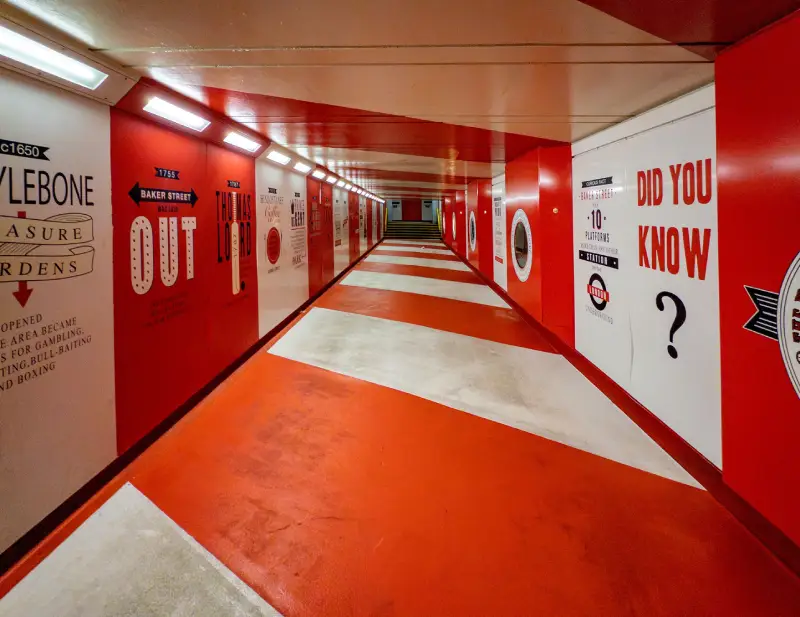
Experiential Branding: When Environmental Graphics Become an Experience
Experiential branding asks not “how does this look?” but “how does this feel?” The surfaces of your space are one of the primary inputs to that feeling, more so than most business owners recognize, because the effect is largely unconscious.
Measurable outcomes of well-designed branded interiors include increased dwell time, higher purchase conversion in retail, reduced perceived wait time in service environments, and higher social sharing rates. These aren’t aesthetic outcomes; they’re business outcomes driven by the environment.
For Alberta businesses, from Edmonton restaurants in Oliver and Whyte Avenue to St. Albert professional offices to Sherwood Park retail, environmental graphics adoption has grown as a direct response to this evidence. Businesses that invested in interior branding before 2020 saw their spaces appear in customer-generated social content throughout the pandemic period, staying visible when their doors were closed. The spaces that generated the most organic sharing were the ones with the most intentional visual environment.
Planning a Branded Interior
A comprehensive environmental graphics project starts with a site survey. The sign company visits the space, documents wall surfaces, ceiling heights, floor materials, existing finishes, and the structural elements that affect what’s possible. This is also when the scope gets defined: which surfaces are included and what the production timeline and budget look like.
Design development follows. For environmental graphics, design isn’t just about what looks good; it’s about what works at scale, in the actual light conditions of the space, on the specific surfaces available. A color that looks rich on a monitor may read differently when printed at 12 feet wide under warm LED lighting on a textured wall. Experienced environmental graphic designers know how to translate brand assets into spatial applications that hold up in real conditions.
Installation is typically a multi-day process for a significant branded interior project. Wall graphics, floor graphics, window films, and ceiling elements may be installed in sequence to avoid damage to completed surfaces during subsequent work. Phased installation over evenings or weekends is common for businesses staying open during the workday. A full-service sign company manages this coordination and handles installation with experienced crews who know how to apply large-format materials cleanly in a commercial environment.
FAQ
What are environmental graphics in a business context?
- Environmental graphics are brand identity elements, logos, colors, typography, photography, and messaging, applied to the architectural surfaces of a commercial space: walls, floors, windows, ceilings, and columns. The goal is a cohesive brand experience inside the built environment, not just at the entrance or exterior. They are distinct from functional signs like exit signs or room number placards, which serve navigation rather than brand expression.
How long do floor decals last in a commercial setting?
- Commercial-grade floor decals with anti-slip laminate typically last 12 to 36 months in normal foot-traffic conditions, depending on volume and flooring type. Smooth sealed concrete and tile give the longest adhesion life; textured or porous floors reduce durability. High-traffic entrances may need replacement annually. A sign company will assess your specific floor surface before recommending a material specification.
Can environmental graphics be removed without damaging walls?
- Most commercial vinyl wall graphics can be removed cleanly from painted drywall when installed correctly with removable adhesive. The key variables are wall surface preparation before installation, paint type, and how long the graphic has been up. Adhesives cure and become more aggressive over time, so a professional installation using the correct adhesive grade for your wall type significantly reduces the risk of paint damage on removal.
What businesses benefit most from environmental graphics?
- Retail stores, corporate offices, healthcare facilities, restaurants, hotels, schools, and gyms see the strongest return because customers or patients spend meaningful time in the space. The longer someone is in an environment, the more impact branded surfaces have on impression and recall. Businesses where customers wait, healthcare waiting rooms, service counters, and lobbies, get particular value because they turn waiting time into brand time.
Are ceiling graphics structural or applied directly to the ceiling?
- Both methods are used depending on the space. Direct-applied ceiling vinyl works on smooth, painted drywall ceilings and is the most cost-effective approach. Suspended fabric graphics hang from the ceiling grid and allow for larger-format, backlit, or shaped elements. A site visit is needed to assess which method works for your space. Ceiling type, height, HVAC placement, and installation access all factor into the recommendation.