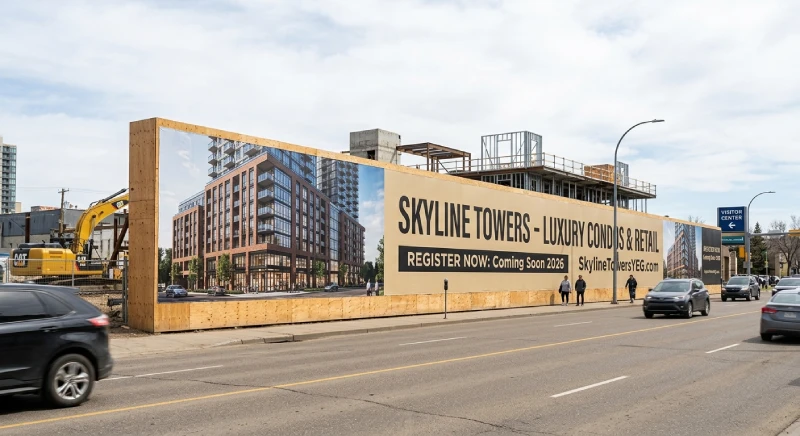
Drive past any active construction site in the Edmonton region and count the ones that are doing anything with the fence. Most are bare chain-link or plain plywood: grey and utilitarian, communicating nothing except that something is happening behind it. For a development that will take 18 months to build, that fence is 18 months of squandered visibility, 18 months of daily impressions going to waste on the traffic that passes by.
Construction site signage is the earliest touchpoint in a project’s marketing funnel. Before the website goes live, before the first ad runs, before the sales centre opens, the hoarding on that fence is what thousands of daily passersby see. For residential and mixed-use developers, it generates pre-registration interest. For commercial developers, it signals activity to the business community. For any project, it tells the neighbourhood what is coming, and shapes perception before the doors open.
This guide covers the main elements of construction site signage: hoarding graphics, fence wrap banners, coming soon signage, and the regulatory and safety signs that every Alberta construction site legally requires. The goal is to help developers, project managers, and marketing teams understand what’s possible and how to brief a sign company to execute it well.
What Is Construction Site Signage and Why It Matters
Construction site signage encompasses all signs installed on or around an active construction or development site. The category splits into two distinct types: regulatory and safety signs, which are required by Alberta law and municipal permits, and brand and marketing signs, which are a strategic investment in building awareness and interest before the project opens.
The regulatory category includes site identification signs required under municipal building permits, contractor identification boards, safety hazard signs required under Alberta’s Occupational Health and Safety Act, and temporary fence signs marking site boundaries. These are non-negotiable, since an inspector can issue a stop-work order for missing required safety signage, and a permit office can require site identification before a building permit is released.
The marketing category is where most developers underinvest, and where the opportunity is largest. A major commercial or mixed-use project in a visible corridor is under construction for one to three years. Every day during that period, people driving past the site are forming a first impression of the project. A well-branded construction hoarding that shows the project vision, communicates the development name, and provides a contact point for interested parties turns that fence into a three-year advertising campaign at no incremental media cost.
Hoarding Graphics: Turning a Fence into a Billboard
Hoarding is typically either plywood panels or chain-link fencing. Hoarding graphics are large-format printed panels applied to this barrier, transforming it from a construction boundary into a brand communication surface.
On plywood hoarding, the standard approach is UV-laminated vinyl graphics applied directly to the painted plywood surface. These are printed in large format, typically in sections of 4 to 8 feet wide that tile seamlessly across the full hoarding run, and show the project rendering, development name, brand colors, and key messaging. For premium developments, full-color architectural renderings of the completed project dominate the composition, with the project name and a single call to action (register your interest, visit the project website, call for leasing information).
The design principles for hoarding graphics are different from standard advertising. The audience is moving by driving or cycling past at speeds that give them two to four seconds to register the image. Text needs to be large and minimal: the project name should be readable at 50 metres, and any secondary text should be no more than five or six words. A single strong rendering or lifestyle image does more than a collage of images. The color palette should be consistent with the project brand and distinct enough from surrounding street-level visual noise to stand out.
For long-duration projects(around 18 months or more) UV-laminated materials are essential in Alberta. Summer UV exposure at Alberta’s latitude is significant, and vinyl graphics without UV laminate can begin to fade or chalk within a single outdoor season. Specify UV-laminated output with a quality cast vinyl base film for anything expected to stay in service through multiple Alberta summers.
Fence Wrap Banners: The Flexible Alternative for Chain-Link Sites
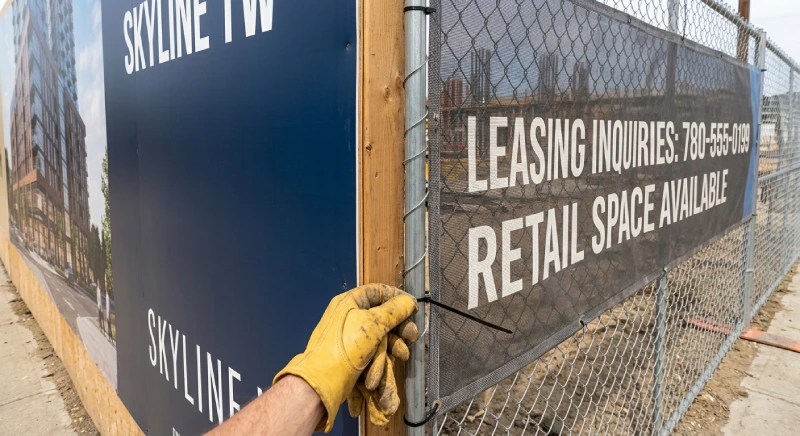
Fence wrap banners serve the same visual function as hoarding graphics but are designed specifically for chain-link fence installations. Rather than applying vinyl to a solid substrate, fence wraps are printed on mesh or solid vinyl material and attached directly to the chain-link with zip ties or woven through the links.
The critical technical consideration for fence wrap banners on Alberta construction sites is wind loading. Chain-link fencing on exposed sites can experience sustained winds that exert significant pressure on any surface attached to the fence. Mesh banners, which have a perforated weave structure that allows air to pass through, handle this exposure far better than solid vinyl banners. The trade-off is print quality: mesh banners have slightly lower resolution due to the open weave, but this is imperceptible at the viewing distances from which construction site signage is read.
Solid vinyl fence wraps are appropriate for lower-exposure sites where wind loading is less of a concern, or where the fence is partially sheltered by buildings or terrain. They produce a sharper, more photographic image quality and a more polished appearance when the site is adjacent to pedestrian traffic that passes close to the fence.
Fence wraps have one significant practical advantage over plywood hoarding graphics: they can be repositioned, extended, or replaced section by section as the site perimeter changes during construction. A development that starts with a fence along one street and later extends its perimeter can add matching fence wrap sections without reprinting the entire run. This modularity makes fence wraps the more practical choice for projects with evolving site boundaries.
Coming Soon Signage: What the Message Should Accomplish
Coming soon signage for a development project serves multiple purposes simultaneously, and understanding each purpose clarifies what the sign should, and shouldn’t, say.
The primary purpose is awareness: people who pass the site should know that something significant is coming and should be able to identify what it is. Project name, development type (residential, retail, mixed-use), and a rough opening window (“Opening 2026,” “Leasing Summer 2026”) give passersby enough information to contextualize what they’re seeing. The rendering shows them what it will look like. Together, these elements create a mental category for the project in the minds of people who are your future customers.
The secondary purpose is pre-sales and pre-registration. A QR code that links to a project landing page, a phone number for leasing inquiries, or a web address for residential registrations turns passive awareness into actionable leads. For residential developers, pre-registration campaigns driven by hoarding visibility are a significant source of early purchasers. For commercial developers, the leasing inquiry generated by a passing tenant who saw the fence banner is exactly the lead the project team wants.
What coming soon signage should not include: construction milestones and timelines (these change and make the sign look outdated), contractor and subcontractor names (your future residents don’t care), permit and bylaw numbers (legal compliance belongs on a separate sign), and specific pricing before pricing is confirmed. The sign is marketing, not a construction document. Every element that doesn’t serve the marketing purpose is visual noise competing with the elements that do.
Development Project Signs: Site ID, Safety and Directional
Alongside the marketing signage, every Alberta construction site requires a set of regulatory signs. These are not optional, and a professional sign company experienced in construction site signage treats them as part of the same integrated package rather than as an afterthought.
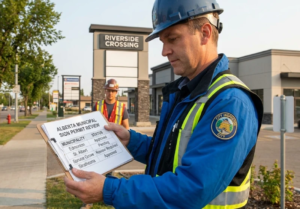
Site identification signs are typically required under the building permit; the municipality wants the project permit number, the property address, and the general contractor’s name and contact information clearly posted at the site. Edmonton, St. Albert, Leduc, and Strathcona County each have their own requirements for format and placement. Getting these details from the permit office before production avoids having to reprint a sign.
Alberta OHS requires construction sites to post hazard identification signs, emergency contact information, and PPE requirement notices at site entry points. These are legal requirements under the Occupational Health and Safety Act and Regulation, and an inspection can result in work stoppages if they are missing. For large or complex sites, a comprehensive safety sign package is typically developed in consultation with the site safety officer.
Development project signs can be integrated into a branded sign system so that even the safety and directional signs share the project’s visual identity. Branded safety signs that use the project color palette and typography, while still meeting all regulatory requirements for content, size, and placement, look intentional rather than generic. The perception of a professionally managed site starts at the fence.
Design Principles for High-Impact Construction Site Branding
The fundamental design constraint of construction site signage is that the primary audience is moving. A driver on a 50 km/h arterial road has approximately three seconds of sightline on a construction fence before it passes. The design needs to communicate in that window.
Single dominant message per sign is the most important design principle. The project name or logo should dominate the composition at a scale that is readable at 50 metres. One strong rendering or lifestyle image. One secondary message line. One contact CTA. Every additional element reduces the effectiveness of each other element. Designers who come from print advertising sometimes underestimate how aggressively this medium demands simplification.
Color contrast between the sign and its environment is the second principle. Construction sites are typically surrounded by raw earth, concrete, and unpainted structural elements: a palette of greys, beiges, and browns. A bold, high-saturation brand color stands out against this background in a way that muted or monochrome palettes don’t. If the project brand uses a soft or neutral palette, consider a strong photographic element that provides the contrast rather than trying to make the brand colors do that work.
Night-time visibility is worth considering for high-traffic sites. Most hoarding graphics are not illuminated, which means they disappear entirely after dark. For projects on corridors with significant evening traffic, externally illuminated hoarding panels, using LED strip lighting mounted above the panels, extend the visibility window substantially. The incremental cost is modest relative to the advertising value of a site that is visible 24 hours a day.
Work with a sign company that offers design-to-installation as a single coordinated service. Construction site signage projects involve multiple sign types, permit requirements, installation scheduling around active construction, and potentially phased production as the site evolves. A sign company with experience in development project signage in the Edmonton region will have the workflows and supplier relationships to execute the full package efficiently.
FAQ
Q1: What materials are used for hoarding graphics in Alberta?
Most hoarding graphics in Alberta use UV-laminated vinyl graphics applied to plywood panels, or large-format mesh banners attached to chain-link fencing. For long-duration projects, UV-laminated cast vinyl significantly extends lifespan under Alberta’s high UV summer conditions. Corrugated plastic (coroplast) panels with printed vinyl are also used for shorter-duration hoarding where a rigid lightweight face is preferred over plywood. The right material depends on substrate type, expected duration, and the level of print quality required at the site’s typical viewing distances.
Q2: How long does construction site signage last outdoors?
UV-laminated vinyl graphics on plywood hoarding typically last two to three years in Alberta outdoor conditions with routine maintenance. Mesh fence banners in exposed sites have a shorter effective lifespan because wind stress on the mesh weave degrades the material at contact points over repeated wind cycles. For projects with durations exceeding 18 months, planning a graphics refresh at the midpoint is common practice for developers who want the site to look maintained and current throughout the construction period.
Q3: Do construction site signs require a permit in Alberta?
Requirements vary by municipality. In Edmonton, temporary construction site signs associated with an active development permit are typically covered under the overall development permit and do not require a separate sign permit, though size limits apply. In St. Albert and Strathcona County, temporary sign rules for construction sites have their own specifications. Your sign company should confirm permit requirements for your specific municipality before production and installation, as the rules differ enough between jurisdictions to affect both sign dimensions and content.
Q4: What should a coming soon development sign include?
An effective coming soon sign for a development project needs the project name with strong visual branding, a realistic opening window rather than a specific date (to allow for construction schedule changes), a high-quality rendering or lifestyle image of the completed project, and a single clear call to action: a URL, QR code, or phone number for people who want to register interest or request leasing information. Keep the sign focused on the marketing message; contractor names, permit numbers, and construction schedule details belong on separate regulatory signs, not on the marketing hoarding.
Q5: Can fence banners withstand Alberta wind?
Mesh fence banners are specifically designed for wind-exposed installations: the open weave structure allows air to pass through rather than creating a full sail effect against the fence. Solid vinyl fence banners require grommets at a minimum every 24 inches and reinforced hems to handle wind loading on exposed Alberta sites; they are better suited to sheltered or urban locations where the fence has partial wind protection from adjacent buildings. For sites on open land or in exposed suburban locations, mesh banners are the more reliable long-term choice regardless of the minor print quality trade-off.