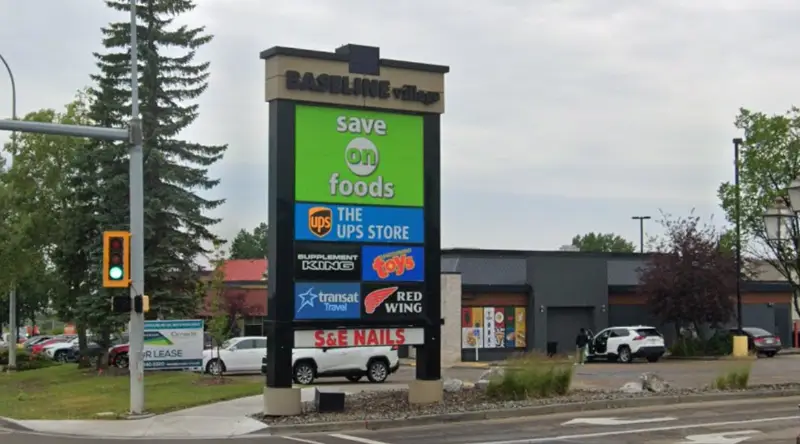
Sherwood Park is one of the largest urban service areas in Alberta that isn’t actually a city. It operates under Strathcona County’s municipal framework, not Edmonton’s. That ends up mattering more than most business owners expect when they start pricing signage, because the rules for where signs can go, how big they can be, and what permits they need are Strathcona County’s, and they don’t match Edmonton’s.
The commercial base here is big and varied: retail strips along Broadmoor Boulevard and Sherwood Drive, business parks in Emerald Hills and Ordze, institutional facilities, light industrial in Heartland and the other Strathcona County industrial zones. Signage needs to run from small office IDs up to full pylons along Highway 16. This guide covers what actually matters: permit requirements, sign options, and how to tell whether the sign company you’re talking to has real local experience.
Strathcona County Sign Regulations
Strathcona County’s Land Use Bylaw covers sign placement, size, type, and illumination throughout the county, including Sherwood Park. Most permanent exterior signs need a development permit from Strathcona County’s Planning and Development department before installation. That covers building-mounted signs, monument signs, freestanding signs, and illuminated displays.
The permitted sign area is calculated from the linear frontage of the commercial unit. More street frontage, bigger allowable sign. For multi-tenant plaza tenants, the calculation usually uses the individual unit’s frontage rather than the whole building. This is worth knowing before you order, because a sign that comes in over the permitted area means either applying for a variance (a formal process with an extra timeline on top) or redesigning.
Illuminated signs (LED channel letters, backlit cabinets, anything with external lighting) have extra requirements. Those cover light direction, brightness at adjacent properties, and the difference between internal and external illumination. The county is fairly consistent in how it reviews permits, but the process isn’t fast. Plan on two to four weeks for a standard review, longer for anything that needs a variance.
Where business owners most often get tripped up is assuming that a sign that would fly under Edmonton’s rules will fly here too. The two bylaws share the same general principles but differ in the specifics. A sign company that regularly pulls Strathcona County permits will know the relevant sections and prepare an application that avoids the common rejection reasons.
Exterior Signage Options
Sherwood Park has most of the same sign options as any major suburban commercial area. What’s right depends on the building situation, the visibility you actually need, and the zone you’re in.
Building-mounted signs on commercial strips
The commercial strips along Broadmoor Boulevard, Sherwood Drive, and Ordze Avenue are the retail heart of Sherwood Park, and building-mounted signs are the default. Illuminated channel letters (individually fabricated dimensional letterforms mounted directly on the building face) give you the best combination of visibility and brand quality. They read clearly in daylight, are visible at night without an external flood, and look premium against most commercial facades.
Cabinet signs (internally illuminated flat boxes with printed or routed faces) are common in multi-tenant plazas where property management has standardized sign infrastructure. The existing sign bands or raceways on the building usually dictate the dimensions a new tenant can work with, so review your lease’s sign criteria schedule before design starts. A sign company that works this market will already know the typical sign criteria for most of Sherwood Park’s larger plazas.
Monument signs in Sherwood Park’s business parks
The business park districts, Emerald Hills, Ordze Business Park, and Heartland, are mostly low-rise office and light industrial buildings set back from the road with landscaped entry drives. Monument signs at entry points are the standard, both for single-tenant properties and for multi-tenant developments where individual panels identify each occupant.
Monument signs in these zones are regulated for height, setback from the property line, and maximum sign area. Panel-based systems, where individual tenant names can be swapped out without replacing the whole structure, are common in Sherwood Park’s office parks. Any sign company that regularly works with them can produce replacement panels that match the existing structure on materials, fonts, and color.
Pylon signs for high-traffic corridors
Businesses with exposure to Highway 16 or the main commercial arterials through Sherwood Park have pylon sign opportunities: tall, freestanding signs designed for highway-speed visibility. Pylons here are regulated for maximum height and area relative to the property and zone. They need development permits and, in some cases, engineering drawings for the structure.
For businesses in the developments right next to Highway 16 interchanges, a pylon is one of the highest-value sign investments available, because the traffic volume it reaches is orders of magnitude past what a building sign gets you. It costs more up front. For hospitality, fuel, and food service, where a chunk of the revenue is impulse-decision traffic, that math usually works.
Interior Signage
Interior signs matter as much as exterior signs for Sherwood Park’s office park sector. A business that looks polished from the outside but has a bare lobby, no wayfinding, and generic room labels is telling visitors something about its standards, and it’s hard to walk that back with strong exterior branding.
Reception lobby signs are the priority for any client-facing office in Sherwood Park. Dimensional logo signs in brushed acrylic, metal lettering, or backlit materials are standard for professional services, financial, legal, healthcare, and technology firms. The reception sign is what ends up in every photo of your space and every client visit.
Wayfinding in the larger commercial facilities, especially the multi-tenant office buildings in Emerald Hills and the retail complexes like Emerald Hills Shoppes and Sherwood Park Mall tenant corridors, needs a coordinated system rather than one-off signs. Overhead directionals, door IDs, elevator lobby directories, and floor level indicators have to work together. Alberta Building Code requirements for accessible signage (tactile and Braille on permanent room signs) apply throughout.
Environmental graphics have been showing up more in corporate offices around Sherwood Park, mostly from companies in oil and gas, engineering, and professional services who want their physical space to match the brand work on their digital side. Wall graphics, mission statements installed as dimensional pieces, and branded corridor treatments are the most common requests. A sign company that handles commercial interior installs can bundle these into a full office fitout package.

Vehicle Graphics for Sherwood Park and Strathcona County Businesses
Sherwood Park has a large trades and service community: plumbers, electricians, HVAC technicians, oil and gas service companies, and logistics operators, most of them running fleets across the county and the greater Edmonton area. Vehicle graphics for these businesses do double duty as mobile advertising in the residential neighbourhoods where their customer base actually lives. Summerwood, Lakeland Ridge, Brentwood, Heritage Hills, Clover Bar Landing.
The case for wraps in Sherwood Park is the same one that works in Spruce Grove or St. Albert. A wrapped truck parked at a job site in a residential neighbourhood is about as precisely targeted as any advertising gets. The homeowners who see it are the exact demographic that hires residential trades, and the impression is free after the initial wrap.
Fleet consistency is worth planning for businesses with three or more vehicles. Matching partial or full wraps across a fleet lands harder in a community than a handful of individually designed trucks. Any sign company that handles fleet work regularly will build a design template that applies across different vehicle types and sizes while keeping the look consistent.
Choosing a Sign Company That Knows Sherwood Park
The practical reason to hire a sign company that specifically knows Sherwood Park is the Strathcona County permit process. Companies whose day-to-day is Edmonton permits are working from a different rulebook, and they’ll either not know Strathcona County’s specifics or take longer to work through them. A company that pulls Strathcona County development permits regularly knows what planning wants, what revisions get flagged most often, and how long approval actually takes on the ground versus what the website says.
Splitting the project across separate vendors, a designer here, a printer there, a local installer, creates coordination risk and accountability gaps that most business owners don’t see coming until something goes wrong. When one company owns design, permit, production, and installation, they’re on the hook end to end. When it’s four vendors, no one is.
When you’re evaluating sign companies for a Sherwood Park project, ask about their Strathcona County permit history specifically, whether they have working relationships with the planning department, and whether they’ve done similar projects in Sherwood Park’s commercial zones. Recent local installations plus a clear explanation of what the permit path looks like for your specific sign type is the combination you’re looking for.
FAQ
Q1: Do I need a sign permit in Sherwood Park?
Yes, most permanent exterior signs in Sherwood Park need a development permit from Strathcona County. That includes building-mounted signs, monument signs, freestanding signs, and most illuminated displays. Temporary signs like real estate and construction site signs run under different rules. Your sign company can tell you whether your specific sign type needs a permit and handle the application with the Strathcona County Planning and Development department.
Q2: How long does a sign permit take in Strathcona County?
Standard sign permit reviews typically take two to four weeks. Applications that need a variance from the bylaw (size, type, or placement outside the standard limits) take longer and go through a more formal review. Plan your signage well ahead of your target opening or change date. Permit review sits on top of design and production lead times, and together those can add six to eight weeks to the full timeline.
Q3: Is Sherwood Park governed by Edmonton’s sign bylaw?
No. Sherwood Park is within Strathcona County, a separate municipality from the City of Edmonton with its own Land Use Bylaw and sign regulations. Businesses in Sherwood Park comply with Strathcona County’s rules, not Edmonton’s. The two differ in specifics like sign area calculations, illumination standards, and the permit process. A sign company with Strathcona County experience will handle those differences correctly.
Q4: What types of signs work best for businesses on Sherwood Park’s retail strips?
For the commercial strips along Broadmoor Boulevard and Sherwood Drive, illuminated channel letters and backlit cabinet signs are the most effective for evening visibility. Window graphics are also common on ground-floor retail for hours, services, and seasonal promotions. For plaza locations set back from the road, a monument sign at the entry drive significantly improves discoverability from the street, especially for businesses that aren’t directly visible from the road.
Q5: Can an Edmonton sign company serve Sherwood Park?
Yes, plenty of Edmonton-area sign companies work in Strathcona County and Sherwood Park regularly. The thing to check is whether the company has direct experience getting Strathcona County development permits, because the process differs from Edmonton’s. A company already familiar with Strathcona County’s permit office, the bylaw specifics, and typical review timelines will get through faster than one treating it as an Edmonton permit under a different address.