
St. Albert has three distinct retail environments, and each one creates different signage challenges. Perron Street, the historic downtown corridor, is a pedestrian-scaled strip where foot traffic moves at walking speed and the distance between a shopper and your sign is measured in metres, not hundreds of metres. The St. Albert Trail commercial strip is a vehicle-oriented corridor where speed is higher, sightlines are longer, and signs need to work from a moving car. The newer commercial nodes near Ray Gibbon Drive and the St. Albert Centre are suburban plaza environments where signage competes within a structured plaza framework and landlord sign criteria govern what you can do.
Each of these environments rewards a different approach. A sign that works well on St. Albert Trail may be the wrong scale and style for a Perron Street boutique. A sign design that suits the heritage character of the downtown may look undersized in a strip plaza. Understanding your specific location and its visual context is where good storefront signage decisions start, and it’s the first conversation a St. Albert sign company should have with you before a design direction is chosen.
The Storefront Sign Challenge in a Competitive Retail Corridor
Walk the length of Perron Street, and you will see a wide range of sign quality, from hand-painted wooden signs on heritage buildings to modern acrylic channel letters on newer retail spaces. That range creates opportunity: an independent retailer with a well-designed, professionally executed storefront sign stands out simply by meeting a standard that many competitors haven’t.
On St. Albert Trail, the challenge is different. You are competing with franchise retailers who have national sign budgets and brand standards developed by teams of designers. An independent business on this corridor that invests in illuminated channel letters and a clean window graphic treatment competes visually with those franchises in a way that a printed banner or DIY vinyl application simply cannot.
The three-second rule applies to both corridors but in different ways. On Perron Street at walking speed, three seconds is enough to read a properly designed sign from across the street. On St. Albert Trail at 60 km/h, three seconds covers about 50 metres of road, so your sign needs to be large enough, bright enough, and simple enough to register at that distance. These are different design briefs, and a sign company that asks about your specific location before starting the design is approaching the project correctly.
Channel Letters: The Gold Standard for St. Albert Storefronts
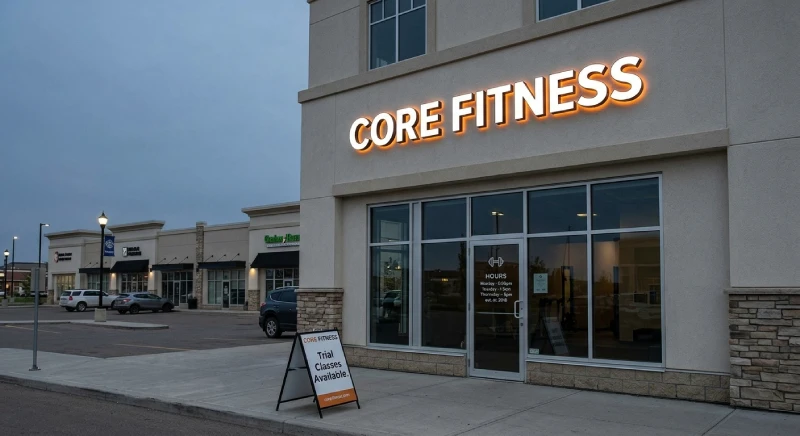
Illuminated channel letters are individually fabricated three-dimensional letter forms with LED illumination built in, mounted directly on the building face. They are the most effective storefront sign type for most St. Albert retail and commercial environments because they provide visibility in both daylight and evening hours, and in Alberta, evening hours matter for a full six months of the year.
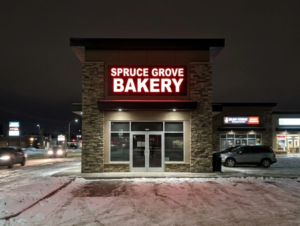
Front-lit channel letters are the standard: the face of each letter is translucent acrylic, the LED modules illuminate the interior of the letter form, and the light projects forward through the face. The effect is a glowing letterform against the building face, clearly visible from a distance in daylight and unmissable at night. This is what you see on most franchise retail storefronts, and it works because it is straightforward, reliable, and effective.
Halo-lit channel letters (also known as reverse-lit or back-lit channel letters) are open-face metal letters with the LED modules pointing backward toward the building face. Instead of the letter glowing, the light spills behind the letter and creates a halo on the wall surface. The effect is more architectural and sophisticated, popular in upscale St. Albert commercial environments: professional services on Boudreau Road, premium retail in newer mixed-use developments, and businesses on Perron Street that want a refined aesthetic appropriate to the heritage character of the street.
City of St. Albert sign permits are required for all channel letter installations. The permit application should include dimensioned sign drawings, the sign area calculation relative to the frontage formula in the bylaw, and an electrical permit application for the illumination components. A sign company that regularly works in St. Albert handles this as part of the project scope, which means you are not navigating the permit office yourself on top of managing an opening.
Window Graphics for St. Albert Retailers: More Than Just Hours
The storefront window is often the highest-traffic sign surface a ground-floor retailer has. On Perron Street, pedestrians pass within arm’s reach of your windows. On a plaza storefront, the window is the surface a shopper reads while walking from their car across the parking lot. Either way, window graphics do more work per square foot than almost any other sign type.
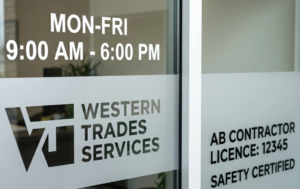
Hours and contact information are the minimum, and they should be professionally applied cut vinyl, not a paper printout in a plastic sleeve. A well-formatted vinyl hours application with your logo, address, phone number, and a social handle looks permanent and intentional rather than provisional. It communicates that you are an established business, which is a more important signal than most retailers realize.
Beyond hours, window graphics can carry seasonal promotions, product highlights, service category descriptions, and promotional messaging that is changed out quarterly or seasonally. Printed vinyl graphics are produced and applied at a fraction of the cost of other advertising mediums, can be removed without damaging the glass, and allow a retailer to refresh the storefront look seasonally without producing new permanent signs. A Perron Street boutique that updates its window graphics for each major season maintains a freshness of presence that a static sign alone cannot provide.
See-through perforated vinyl opens up the full window surface for advertising while maintaining interior visibility and natural light. For retailers with large display windows, a well-designed full-window perforated graphic creates a storefront presence that is genuinely billboard-scale at street level. For businesses where window visibility into the store is part of the appeal, perforated vinyl provides the advertising value without closing off the visual connection with the street.
A-Frame and Pavement Signs: The Sidewalk Sell
Perron Street and the pedestrian-scale commercial streets around St. Albert’s downtown area are where sidewalk signs genuinely earn their keep. An A-frame sign positioned on the sidewalk in front of your entrance intercepts foot traffic before they even reach the building. It reads at a distance of two to three metres, and it can carry a message that changes daily or weekly without reprinting.
Printed insert A-frames use a replaceable graphic panel in a weatherproof frame. You can carry a library of seasonal or promotional panels and swap them as your message changes, at a material cost of a few dollars per panel. The frame itself is a one-time investment that lasts years. For retailers who run regular promotions, events, or seasonal specials, printed insert A-frames are the most cost-effective changeable sign available.
St. Albert’s Business Improvement Area (BIA) for the downtown has guidelines governing sidewalk sign placement; specifically, signs must not obstruct the minimum pedestrian clear path width on the sidewalk and must be removed when the business is closed. Confirming the current BIA guidelines before ordering a sidewalk sign saves the frustration of having a sign that isn’t permitted at the intended location. Most standard A-frame sizes and placements comply with the clear path requirements, but it’s worth checking the specific dimensions for your storefront.
Business Signage Solutions St. Albert: Matching the Sign to the Business
Different business categories have different sign priorities, and the most effective storefront sign strategy accounts for what your customers are actually looking for when they first see your sign.
Quick-service food businesses benefit from high-contrast, high-visibility signage that includes menu category information and hours prominently. A customer deciding between lunch options while driving along St. Albert Trail makes that decision partly based on what your sign communicates in the seconds they have to read it. “Breakfast all day” or “Halal” or “Open until 10” is more useful on the sign than a tagline.
Boutique and specialty retail on Perron Street and in the premium retail areas of newer St. Albert commercial nodes benefit from a different emphasis: brand aesthetic first, information second. A beautiful dimensional logo sign with high-quality materials communicates that the business inside is worth the premium, before the customer even steps through the door. Custom signs St. Albert boutique retailers use for this purpose include brushed metal lettering, dimensional acrylic logos, and premium halo-lit channel letters.
Professional services benefit from clean, restrained signage that communicates credibility and discretion. A frosted window graphic with the practice name and professional designations in an elegant layout tells the right story. Illuminated signs are appropriate for professional services that have evening hours; for strictly daytime operations, non-illuminated dimensional signs can be the more appropriate aesthetic choice.
New Business Signage Checklist for St. Albert Retailers
If you are opening a new business in St. Albert, signage should be on your planning timeline from the day you sign the lease, not from the week before opening. The full sequence from first consultation to installed sign typically takes four to eight weeks for permitted exterior signs, and the permit application cannot be submitted until you have a design, which means the design process needs to start at least eight weeks before your target opening date.
Step one is reviewing the sign criteria in your lease. Commercial leases for plaza and mall tenants include a sign criteria schedule that specifies what types of signs are permitted on your unit, the maximum sign area, permitted illumination types, and any landlord approval requirements. This document governs your sign design before the City of St. Albert’s bylaw does. A sign company familiar with St. Albert commercial leases will read the criteria before starting design and will not propose a sign type that your lease prohibits.
Step two is the City of St. Albert development permit application. Your sign company prepares the application and submits it to the City of St. Albert Planning and Development Services. Permit review typically takes two to four weeks. For illuminated signs, an electrical permit is filed separately by the electrical contractor and runs in parallel with the sign permit.
Step three is production and installation, which happens after both permits are approved. Illuminated channel letters typically take two to three weeks from design approval. Window graphics and A-frames can be produced in a few days. Having a clear critical path for each sign type, with the permit timeline built in, is how you avoid the situation of being open for business without a proper sign in place.
FAQ
- What is the best storefront sign for a St. Albert retailer? – For most St. Albert retailers in lit commercial corridors, illuminated channel letters are the strongest single investment; they provide visibility in both daylight and evening hours and communicate a professional, established presence. For ground-floor retailers on pedestrian-focused streets like Perron Street, combining a high-quality window graphic with a dimensional logo sign or well-proportioned channel letters maximizes impact at the close reading distances of a walking audience.
- How much do custom storefront signs cost in St. Albert? – Custom storefront sign costs vary significantly by type. Window vinyl graphics start from a few hundred dollars for a simple hours application and scale to several thousand for a full-window perforated graphic with complex design. Channel letter signs for a typical St. Albert retail space range from approximately $3,000 to $8,000 installed, depending on letter count, size, and illumination type. A dimensional lobby or storefront logo sign in acrylic or metal ranges widely based on materials and scale. A sign company will provide a detailed quote after reviewing the space and understanding your requirements.
- Do I need a sign permit for a storefront sign in St. Albert? – Yes, most permanent exterior signs in St. Albert require a development permit from the City of St. Albert Planning and Development Services. Your sign company can prepare and submit the permit application. The process typically takes two to four weeks for a standard application. Window graphics below the bylaw’s size exemption threshold may not require a permit, but confirm with the city before installation, and the threshold varies and is not always intuitive.
- Can I get a custom sign for a storefront on Perron Street? – Yes, with some additional considerations. Perron Street is within St. Albert’s downtown heritage area, and some properties have design guidelines that apply beyond the standard sign bylaw. These guidelines may affect sign type, materials, illumination, and color choices to ensure new signs are compatible with the heritage character of the street. A sign company with experience in the Perron Street area will know whether your specific property has heritage overlay requirements and will design within them from the start.
- How long does it take to get a storefront sign made in St. Albert? – From first consultation to installed sign, a typical illuminated channel letter sign in St. Albert takes five to seven weeks: one to two weeks for design and landlord/client approval, two to four weeks for City of St. Albert permit review, two to three weeks for production, and installation scheduled once permits are approved. Window graphics and A-frames move much faster, often one to two weeks from design approval to installation. Starting the process eight weeks before your target opening date gives you a comfortable buffer for the common sources of delay.