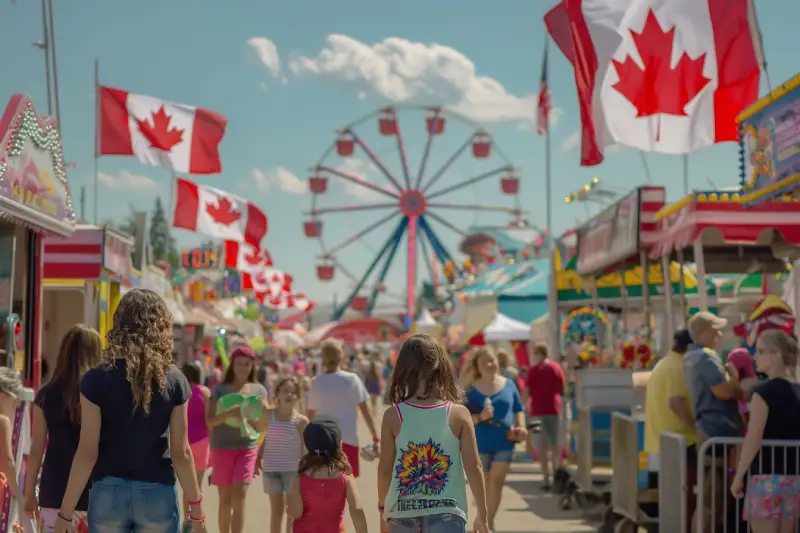
Alberta’s outdoor festival season runs from May through September, and across that stretch, hundreds of vendors compete for attention at farmers’ markets, heritage festivals, craft shows, and summer fairs. The Heritage Festival in Edmonton alone draws 400,000 visitors over a long weekend. The K-Days midway fills. The Whyte Avenue Art Walk packs both sides of a street that’s already known for crowds. In that environment, the quality of your product matters less than most vendors think, at least in the first three seconds. What matters is whether a passerby’s eyes stop on your booth at all.
Event signage is the answer to that problem. A well-designed, properly positioned set of festival signs does one job before any conversation begins: it pulls people toward your space. This guide covers the event signage ideas that work specifically for Alberta’s outdoor market and festival context, what to use, where to put it, and how to make it hold up through a full season of setup, teardown, wind, and UV exposure.
Why Your Booth Signage Is Your Most Important Sales Tool
Walk any Alberta summer festival and count the booths that are difficult to read from ten feet away. Most of them have typography that is too small, background colors that blend into the surrounding canopy, or the sign is placed at table height where it competes with the product display rather than rising above it. These are solvable problems, and they’re worth solving before the season starts.
The three-second rule is the operating reality of festival retail: a person walking past your booth will form a first impression in about three seconds, and in that window, they’re not reading your text; they’re registering color, contrast, and whether your display looks like something worth stopping for. Signage that works at this scale means high contrast between text and background, a single dominant message per sign, and at least one element positioned at standing eye height or above.
Placement matters as much as design. A banner laid flat on a table is competing with your products. A retractable banner stand positioned at the front corner of a 10×10 canopy rises above the crowd and reads from a distance. Understanding that distinction, vertical over horizontal, above eye level over below, is the starting point for booth signage that actually drives traffic.
The Core Event Signage Ideas Every Vendor Should Use
A standard festival booth setup doesn’t need a dozen sign types. It needs four or five that cover different roles: distance visibility, close-up product information, brand consistency, and the promotional message of the day. Here’s how those roles break down by sign type.
Retractable Banner Stands
The retractable banner stand, sometimes called a roll-up banner, is the workhorse of festival booth signage. A standard 33″x 80″ banner stand extends above canopy height when placed at the front corners of a 10×10 booth, giving you readable signage from across an aisle or a vendor row. They set up in under a minute, weigh about eight pounds, and store in a compact carry bag that fits in most vehicles alongside your other gear.
For festival use, the banner should lead with your business name or a high-contrast logo at the top third, followed by a short tagline or your primary product category. Keep it to five or six words of readable text. The bottom third can include a website or social handle, but assume most passersby won’t be close enough to read it, design primarily for distance.
Custom Printed Tablecloths and Skirts
A full-bleed custom-printed tablecloth is one of the highest-value signage investments for a vendor who does multiple events per season. It covers the front and sides of your table in consistent brand colors and logo, which reads as professional from across the aisle even before anyone sees your products. It also solves a practical problem: whatever folding tables the event provides, your branded cover makes them look intentional.
Printed polyester tablecloths with stretch fit are durable across many wash cycles, dry quickly after unexpected rain, and pack flat. Having your business name visible on the table itself means your brand is present even during setup and breakdown, when foot traffic still exists.
Feather Flags and Teardrop Banners
Motion catches the peripheral vision in a way that static signs don’t. A feather flag or teardrop banner at the entrance to your booth creates constant movement in even light wind, which is one of the most effective ways to pull eyes from a distance in a crowded outdoor setting. Alberta summer events reliably produce some breeze; most open-air festival sites are exposed enough that flags will move almost all day.
Position feather flags at the front corners or just outside your booth footprint where the event organizer permits. For events on grass, ground stakes are standard. For hard surfaces, a weighted cross base works. Check the specific event’s vendor guidelines before assuming you can stake anything into the ground; some venues, particularly park settings in Edmonton and St. Albert, restrict this.
A-Frame Sidewalk Signs
An A-frame chalkboard or printed insert sign at the front of your booth handles a different job than your banners: it communicates today’s specific offer, a key product price, or a promotion. “Fresh bake, $8 per dozen” is more effective on an A-frame than on a permanent banner, because you can change it without reprinting.
Printed insert A-frames (where you slide in a paper or coroplast sheet) give you a more polished look than chalkboards while still allowing message changes between events. They’re lightweight, fold flat for transport, and occupy a minimal footprint in front of the booth. Some vendors use two: one at each front corner, with complementary messages.

Festival Booth Signage That Works for Alberta’s Outdoor Conditions
Alberta’s festival climate is specific. You’re dealing with strong UV radiation at altitude on clear summer days, afternoon temperatures that can spike past 30°C, and wind exposure on most open-air sites. In a single weekend at a venue like Hawrelak Park or Spruce Grove’s Horizon Park, a cheap banner can start to show UV fade, develop water marks from an evening rain, or begin to curl at the edges if the substrate isn’t appropriate for outdoor use.
For any sign that will see multiple seasons, vinyl banners with reinforced hem stitching and welded grommets are the right choice. Thirteen-ounce scrim vinyl is the standard for outdoor banners, heavier than the promotional-grade material that some online print services use, and significantly more resistant to UV yellowing and moisture. If you’re investing in a banner stand, make sure the printed graphic uses UV-laminated or UV-coated output, not bare inkjet print.
Fabric banner stands look sharper up close than vinyl and photograph better, which matters for vendors who document their booths for social media. They’re a good choice for interior or sheltered outdoor events, craft shows in a pavilion, or indoor market halls. For fully exposed outdoor sites, coated vinyl will outlast fabric across a full Alberta summer season. A sign company experienced with Alberta outdoor signage can recommend the right material specification for your specific use pattern.
Summer Event Marketing in Alberta: Layering Signage with Your Brand Strategy
The most effective festival booths don’t just have good individual signs; they have visual consistency across every element. The same color palette on the tablecloth, the banner, the product packaging, and the canopy sidewall tells a story that individual elements can’t tell alone. Visitors to Alberta’s larger festivals walk past dozens of booths, and the ones that are remembered are almost always the ones with a coherent look, not necessarily the ones with the most signs.
Start with your brand colors and commit to them across all printed materials. If your logo is deep green and white, your banner background, tablecloth, and any display cards should work within that palette rather than introducing new colors. The canopy itself doesn’t need to match exactly; most vendors use a neutral canopy color, but the signage and branded materials should read as a unified system.
Consider how your booth photographs. Alberta’s summer events generate enormous social media content from attendees, and a visually consistent booth that photographs well gets organic promotion whenever someone posts from the event. Vendors at events like the Edmonton Folk Music Festival or the Strathcona Farmers Market often appear in dozens of visitor photos over a single weekend. Your signage is present in all of them.
Portable Business Signs for Vendors Who Do Multiple Events
A vendor who does five or more events per season is operating under different conditions than someone who sets up once at a neighborhood fair. Modularity and durability become the priority. Signs that can be assembled and broken down in under fifteen minutes, fit in a standard cargo van, and hold up across fifty or more cycles of setup are worth the additional investment over signs built for single use.
Retractable banner stands meet this bar well; quality stands have mechanisms rated for hundreds of cycles. Printed tablecloths wash and fold. A-frames collapse flat. The element that trips up multi-event vendors most often is the canopy itself, which isn’t technically signage but which interacts with your signage system. If you’re attaching side-wall banners or velcro-mounted signs to your canopy frame, know the frame dimensions before ordering any hardware-attached signage.
For vendors who rotate through different event types, outdoor markets on weekends and indoor trade shows or pop-up retail environments during the week, a modular sign system that works in both settings saves money and storage space. Fabric backdrops with a stand system are one of the more versatile options: they work as a branded wall at a trade show booth and can be repositioned as a backdrop behind a farmers market table. A sign company that handles event signage regularly can advise on which products crossover between indoor and outdoor formats without performance compromise.
Design Tips for High-Impact Booth Signage
Legibility at distance is the first design requirement. For a banner being read from fifteen feet away, text below 96-point (roughly three inches of cap height) is too small for comfortable reading in a crowded environment. Lead with the most important word in your business name or product category in large type, and subordinate everything else.
Contrast is more important than color preference. A yellow logo on a white background may look clean in a design file but disappear in direct sunlight at an outdoor event. High-contrast combinations, dark text on a light background, or a vibrant color on a dark background, perform consistently across different lighting conditions, including the late-afternoon low-angle sun that’s common at Alberta summer events.
QR codes have become standard on festival signage. They work best on A-frames and tablecloths, where someone is close enough to scan, rather than on banners meant to be read at a distance. If you use a QR code, make sure it links to a mobile-optimized destination, an Instagram profile, a menu, or an online store, since nearly all QR scans at outdoor events come from a phone.
If you’re selling at events in Edmonton’s diverse festival circuit, particularly the Heritage Festival, which represents more than 60 cultural pavilions, consider whether any signage should accommodate French or a second language relevant to your products. Most vendors don’t need bilingual signs, but for food vendors representing a specific cultural tradition, native-language elements on the sign can actually be an attraction and a conversation starter.
FAQ
Q1: What are the best event signage ideas for a small festival booth?
For a small booth, prioritize a tall retractable banner for vertical presence, a printed tablecloth for brand consistency, and one A-frame sign at the entrance with your offer or a daily special. Keep text minimal; five words or fewer per sign works best in high-traffic environments. These three elements cover distance visibility, close-up brand identity, and today’s promotional message without requiring a large setup footprint.
Q2: What sign materials hold up best at outdoor Alberta events?
Vinyl banners with reinforced hems and grommets are the standard for Alberta outdoor events because they resist wind, UV, and moisture. For fabric banner stands indoors or in sheltered areas, polyester dye-sublimation prints look sharper up close. Avoid paper-based prints at outdoor festivals; they degrade quickly in direct sun. For any sign that will see multiple seasons, UV-laminated or UV-coated printing significantly extends the lifespan.
Q3: Do I need special permits for festival booth signage in Alberta?
Permit requirements depend on the event organizer, not a municipal authority. Most Alberta farmers’ markets and community festivals allow standard freestanding signs within your booth footprint. Check with the event coordinator about maximum banner heights and whether staking flags into the ground is permitted at the specific venue. Some Edmonton parks and Strathcona County event sites restrict ground stakes and require weighted bases instead.
Q4: How far in advance should I order signage for a summer event?
For custom-printed festival signage, order at least two to three weeks before your first event to allow for design approval, production, and shipping. If you need rush production, ask your sign company about turnaround times; some items like retractable banners can be turned around in three to five business days. Leaving signage to the last week before a major event is a common mistake that results in generic or compromise solutions.
Q5: Can the same signs work for both indoor trade shows and outdoor festivals?
Many sign types cross over well between environments. Retractable banner stands, A-frames, and fabric backdrops work indoors and out. The main consideration is material: outdoor events need UV-stable, weather-resistant materials, while indoor trade shows allow lighter fabrics and non-laminated prints that look cleaner under exhibition lighting. A sign company can advise on specifications that handle both formats without compromise.