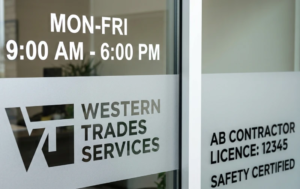

Retail signs in Edmonton work harder than most store owners realize. Before a customer parks, before they read your hours, before they decide whether to push the door open, your signage has already made a call on your behalf. In a city where most shopping trips happen by car and corridors like Whyte Avenue, 124 Street, and South Edmonton Common pull real volume, the stores that get noticed are not always the ones with the best product. They are often the ones with better signs.
This guide covers the sign types Edmonton retailers use most, how exterior and interior signage fit together as a strategy rather than separate purchases, what the City of Edmonton’s sign bylaw actually requires for temporary signs, and how to plan seasonal campaigns without ending up in a last-minute rush.
What Edmonton Retailers Actually Need From Their Signs
Generic sign advice tends to treat all retail environments the same. Edmonton is not generic.
The city’s retail sector is still rebuilding from a rough stretch. The Edmonton Chamber of Commerce tracked the downtown workforce dropping from 60,000 before COVID to around 9,000 in 2021. According to CBC reporting on the recovery, Puneeta McBryan, CEO of the Edmonton Downtown Business Association, put it plainly: “People and foot traffic, i.e. customers, is what drives retail demand and everything else economically.” That is as true on Whyte Avenue as it is in City Centre.
The context is sharper than most retailers realize. A 2023 streetfront retail study from the University of Alberta found that only 66% of downtown Edmonton streetfront units were occupied as of May 2023 — meaning one in three nearby storefronts was sitting empty. An occupied business with clear, readable signage draws disproportionate attention on a block where a third of the storefronts offer none.
Which means visibility is not a vanity project. On corridors where most customers arrive by car, an exterior sign that cannot be read from 30 metres at 50 km/h is not doing its job, regardless of how good it looks up close. The sign gets one shot before the car passes.
Edmonton’s winters add a second layer. Temperature swings of 40 degrees between November and March, freeze-thaw cycles, and the compressed daylight hours of December and January all affect how signs perform and how long materials last. Getting the specification right the first time costs less than replacing a sign that failed after two winters.
Every retail sign needs to do one of two things: attract customers from the street, or convert them once they are inside. Signs that try to do both at once tend to do neither well. Thinking about those two jobs separately before ordering anything is a useful discipline.

What the 2023 Edmonton Retail Report Tells Us About Signage
The University of Alberta’s Centre for Cities and Communities surveyed every streetfront retail unit in the downtown BIA in May 2023. The data is specific to downtown, but the commercial dynamics it describes apply across Edmonton’s retail corridors. Here are the findings most relevant to how any Edmonton retailer should think about their signs.
| Data Point | What the Report Says | What It Means for Retail Signage |
| 66% occupancy rate downtown (33% vacant) | As of May 2023, a field survey across the downtown BIA. 1 in 3 streetfront units was unoccupied. | Occupied retailers benefit from the attention vacuum left by empty neighbours. A professional sign does more work when the storefront beside you is dark. |
| Food, dining and hospitality = 40.73% of occupied storefronts | Largest single category by far. Casual and upscale dining alone accounts for 22.75%. | Restaurants are the primary occupied retail type downtown. Channel letters, illuminated cabinet signs, A-frames, and window menus all apply directly. |
| Average retail bay: ~1,200 sq/ft in 2023 (was 5,000 sq/ft in 1990) | Smaller physical footprints are the new norm across North America, including Edmonton. | A smaller store cannot rely on interior size to create presence. Exterior signage carries more brand weight per square foot than it did a generation ago. |
| Blade signs and awnings improve consumer sight awareness for drivers and pedestrians | Cited in the report Appendix as a key beautification and retail visibility tool for the downtown BIA. | Projecting signage (blade signs) increases storefront legibility from multiple approach angles, not just head-on — directly relevant to Edmonton’s mixed pedestrian and vehicle traffic. |
| $1 public beautification investment generates $3 private sector return | Cited from Bloomberg / urban economics research referenced in the report. | The broader investment argument applies to individual storefront signage: visible, well-maintained signs attract customers who then spend. The return is measurable. |
Source: Downtown Edmonton Streetfront Retail Report 2023, Centre for Cities and Communities, University of Alberta. Blade signs and awnings data from report Appendix. Beautification ROI figure cited from Bloomberg via the report.
Exterior Retail Signs in Edmonton
Your exterior signage is everything a potential customer sees before entering. For most Edmonton retailers, that means several sign types working together rather than a single dominant sign.
Channel Letters and Building-Mounted Signs
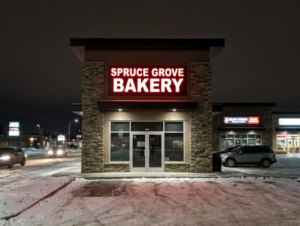
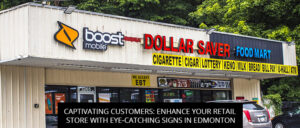
Channel letters are individually fabricated three-dimensional letters mounted to a building facade. Internally illuminated channel letters stay visible after dark, which matters for retailers open through Edmonton’s long winter evenings. For strip mall tenants on corridors like Calgary Trail, 99 Street, or 137 Avenue, building-mounted signage is often the only exterior branding available at the unit level.
Two practical considerations for Edmonton installations: size letter height for the actual viewing distance, not how it looks on a design mockup. A letter that reads clearly from five metres is undersized for a storefront facing a four-lane arterial at 60 km/h. Mounting to EIFS (synthetic stucco), common on Edmonton commercial buildings, requires specific fasteners and proper weatherproofing at each penetration point to prevent moisture from entering the wall assembly over time.
It is also worth noting that the same University of Alberta report specifically identified blade signs and awnings as tools that “allow businesses to have better sight awareness to the consumer (driving and pedestrian) as well as visual appeal and historical charm.” Projecting signage that extends perpendicular to the building face catches customers approaching from multiple angles, not just head-on. On a busy pedestrian street or a mixed-traffic corridor, that additional sightline matters.
Pivotal produces and installs storefront signs across Edmonton, covering channel letters, cabinet signs, blade signs, and illuminated formats for retail, service, and commercial buildings.
Window Graphics and Vinyl Lettering
Window graphics are probably the most underused exterior sign asset in Edmonton retail. A well-designed vinyl window graphic communicates hours, services, and promotional offers to anyone who approaches on foot or by car, including people who show up when you are closed. For retailers in high-pedestrian areas like Whyte Ave or around Ice District, a window graphic is a 24-hour sign that requires no electricity and, in most cases, no permit.
The shift toward smaller retail formats makes this more relevant, not less. The University of Alberta report noted that the average retail bay in Edmonton is now around 1,200 square feet, down from 5,000 square feet in 1990. A smaller footprint means less interior surface area to establish brand presence. Your windows become a proportionally larger share of what customers see from the street.
For professional offices alongside retail, frosted window film creates privacy on street-level glass without blocking light. That matters in Edmonton, where the short daylight hours of November through February mean interior lighting has more street-facing impact than it does in summer.
On material: cast vinyl outperforms calendered vinyl on south and west-facing windows where UV exposure and summer heat are significant. A UV-rated overlaminate on those exposures extends graphic life from two or three years to five or more. The price difference per square foot is small; the replacement cost difference is not.
Browse window graphics options for Edmonton retail and commercial storefronts.

A-Frames and Sidewalk Signs
A-frames earn their place in Edmonton retail for one reason: they reach pedestrians at the exact moment a decision is being made. A clear, current message on an A-frame in front of a door can tip a browsing customer toward entering in a way that no permanent sign can, because the message can change with the day, the week, or the promotion.
Before ordering, though, it is worth knowing where Edmonton’s bylaw draws the line. Under Zoning Bylaw 20001, portable signs on private property (your own sidewalk or forecourt) generally do not need a development permit, provided they meet the applicable size and placement conditions. Signs on a public sidewalk are a different category and may require a temporary sign licence from the City. If your storefront opens directly onto a public sidewalk, confirm placement before installing.
Banners and Feather Flags for Seasonal Promotions
Banners and feather flags are the tactical layer of Edmonton retail signage: high-visibility, relatively low-cost, and meant to rotate with your promotional calendar. Feather flags create motion, which draws attention from a distance in a busy parking lot where shoppers are looking around rather than at specific storefronts.
For Edmonton conditions, specify mesh vinyl for any banner staying up outdoors through shoulder season or winter. Solid vinyl catches wind the way a sail does during the Chinook-effect gusts that come through during warm spells, and the hardware stress adds up fast. Mesh lets wind pass through, and typically outlasts solid vinyl by a full season or two in Alberta outdoor conditions.
Interior Signs That Move Product
Interior retail signage operates on a different logic than exterior. Outside, you are stopping someone in motion. Inside, you are directing attention and shortening the distance between curiosity and purchase.
The core interior sign types: overhead department and aisle identifiers that let customers navigate without asking, shelf-edge signs that flag specific products, point-of-sale signs at the register for last-minute add-ons, and promotional posters or window clings that carry active offers. None of these are complicated. The complication is usually that they accumulate over time without a consistent format, and the result is a store that looks less organized than it is.
Building a simple format system for interior signs (consistent type size, consistent colour, consistent dimensions by sign category) solves most of this. It does not require redesigning everything at once. It requires setting the standard and applying it as existing signs get replaced.
For more on how in-store sign placement affects buying behaviour, see our guide to retail display signage that influences buying decisions inside stores.
Seasonal Signage for Edmonton’s Retail Calendar
Edmonton retail has four signage seasons, and the businesses that plan for them in advance get better results and pay less than the ones ordering signs two weeks before they need them.
Back-to-school runs late July through August. Retailers in school supplies, clothing, and electronics should have seasonal window graphics and interior signs in place before mid-July. Production lead time on custom window graphics from an approved design is typically five to seven business days; ordering in early July gives you room for a round of revisions without cutting it close.
The holiday season is the highest-stakes period. Black Friday through Christmas is when seasonal signage has the clearest measurable impact, and it is also when every other retailer is ordering at the same time. Having your holiday window graphics, promotional banners, and interior seasonal signs installed before the first weekend of November keeps you ahead of the queue and avoids rush charges. Order in mid-October.
Spring refresh in March and April is the transition point where holiday graphics come down and the visual environment resets. It is also the right time for a maintenance check on exterior signage after an Edmonton winter, specifically checking for fastener loosening, weatherstripping condition on illuminated cabinets, and vinyl edge lifting from freeze-thaw cycles.
Pivotal handles large-format printing for seasonal retail campaigns across Edmonton and surrounding areas.
Planning note: Design seasonal graphics without year-specific text or dated promotional copy and they can be stored and reused the following season. Specify cast vinyl, store graphics flat in a cool dry space, and you can get two or three seasons from one print run.
Edmonton Sign Bylaw: What Retail Businesses Need to Know
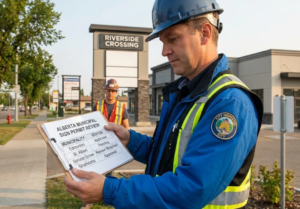
The City of Edmonton regulates retail signage through Zoning Bylaw 20001 and the associated Sign Regulations. The rules that come up most often for retailers involve temporary signs: A-frames, feather flags, banners, and window graphics that rotate with promotions.
Permanent signs (channel letters, cabinet signs, monument signs) require a Development Permit from the City. The permit application needs drawings showing sign dimensions, placement, and illumination specifications. Four to eight weeks from submission to approval is a reasonable planning baseline for a standard retail storefront sign, though complex applications or those requiring variances can take longer.
Temporary promotional signs on private property generally fall under simplified rules that allow placement without a development permit, provided the sign meets the bylaw’s size and duration limits for the applicable zone. Retail commercial zones and neighbourhood commercial zones have different allowances. For signs on or over a public sidewalk or right-of-way, a separate City licence is required regardless of sign size.
One point specific to Alberta: accessible signage in commercial spaces in Canada is governed by provincial building codes and the CSA B651 standard (Accessible Design for the Built Environment), not the ADA. If your retail space requires accessible signage for restrooms, exits, or wayfinding, CSA B651 is the applicable standard. Pivotal’s team works within the Alberta regulatory framework for these installations.
If you are opening a new Edmonton retail location and are not sure whether your planned signage requires a permit, the most reliable approach is having your sign company conduct that research as part of the project scope. Pivotal handles permit applications as a standard part of the process.
More on the permit process: sign application and permitting in Edmonton and area.
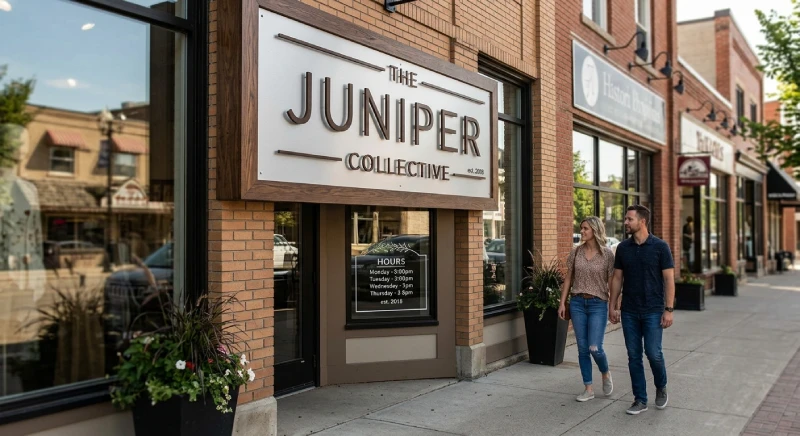
How to Keep Your Retail Signs Looking Professional Year-Round
Edmonton winters do specific things to exterior signs that more temperate climates do not. Freeze-thaw cycling is the most consistent issue: water that gets into small gaps in vinyl graphics, cabinet seals, or around mounting hardware expands when it freezes and opens those gaps a little further each cycle. By the time the damage is visible from the street, it has usually been building for months.
A pre-winter inspection in October is the most cost-effective maintenance practice for Edmonton retailers with exterior signage. Check fastener condition on building-mounted signs, inspect weatherstripping on illuminated cabinet signs, and look for edge lifting on vinyl graphics. Addressing these things before the first hard freeze costs considerably less than repairing a sign that has spent a winter with compromised seals.
For illuminated signs specifically: the shorter days of December and January mean your sign is running more hours per day during the period when it matters most. Burned-out LED modules that were barely noticeable through summer become obvious gaps in your exterior presentation during evening shopping hours. Replace them before the holiday season.
Pivotal provides sign maintenance and repair for retail and commercial clients across Edmonton, Sherwood Park, St. Albert, and Spruce Grove.
Frequently Asked Questions
- What type of exterior sign works best for a retail storefront in Edmonton? – For most Edmonton retail storefronts, a combination of a building-mounted sign (channel letters or cabinet sign) for primary identification and a window graphic for secondary messaging covers both the distance visibility job and the close-up communication job. The right primary sign type depends on the building configuration, lease terms, and where the primary traffic approaches from. A site assessment before design avoids the common problem of specifying a sign the landlord will not approve or that the zone does not permit.
- Do Edmonton retailers need a permit for window graphics or A-frame signs? – Window graphics on your own storefront glass generally do not require a development permit in Edmonton, provided they fall within the bylaw’s allowances for the zone. A-frames and portable signs on private property also typically fall under simplified rules that do not require a permit, subject to size and placement limits. Signs placed on a public sidewalk or right-of-way require a separate City licence. Requirements vary by zone and sign type, so confirming the specifics for your address before ordering is the safer approach.
- How often should I update my in-store promotional signage? – Promotional signs should rotate with your marketing calendar, roughly every four to eight weeks for most Edmonton retailers. Evergreen signs (department identifiers, navigational signage) should be reviewed annually and replaced when fading, damage, or outdated information makes them inaccurate. Window graphics for seasonal promotions follow the same cadence as interior promotional signs. Permanent brand elements get replaced when they no longer reflect the current brand or when the physical condition warrants it.
- How do Edmonton winters affect retail sign materials? – Freeze-thaw cycling is the main issue. Water that gets into gaps in vinyl graphics, cabinet seals, or around mounting hardware expands when it freezes and progressively opens those gaps further. Cast vinyl outperforms calendered vinyl in Alberta conditions, and powder-coated metal components outlast painted finishes against road salt and freeze-thaw stress. For illuminated cabinet signs, silicone weatherstripping rated for a wide temperature range maintains its seal through Edmonton’s full seasonal swing better than standard EPDM rubber.
- Can Pivotal Signs help with both exterior and interior retail signage in Edmonton? – Yes. Pivotal handles the full scope from consultation through design, fabrication, permitting, and installation. That covers exterior channel letters, building-mounted signs, window graphics, interior promotional and wayfinding signs, large-format printing for seasonal campaigns, and ongoing maintenance. Pivotal serves Edmonton and the surrounding area, including Sherwood Park, St. Albert, Spruce Grove, and Leduc.
Ready to update your retail signage?
Whether you are opening a new Edmonton retail location or refreshing signs that have been up for a few years, Pivotal Signs handles the full process. Request a free consultation and the team will assess your site, advise on sign types and permit requirements, and give you a realistic timeline before you commit.
Browse the storefront signs service page for format options, or contact us through any of the Edmonton, Sherwood Park, St. Albert, or Spruce Grove locations.