
Opening a new business in St. Albert comes with a long pre-launch checklist: business registration, lease finalization, insurance, inventory, staffing. Signage appears on that list almost as an afterthought for most new owners, and it shows. Businesses that leave signage to the final two weeks regularly face delays, a missing exterior sign at opening, an unlit storefront after dark, or interior wayfinding that doesn’t exist yet when the first customers walk in.
Signage is infrastructure, not decoration. Your exterior sign is what tells people the space is occupied and open. Your interior signs are what make the space function. Getting this right before launch day means understanding what you need, in what order, and how long each item takes to produce and install. This checklist is designed specifically for new businesses opening in St. Albert, with the permit process, corridor context, and sign typology of this community in mind.
Why Signage Should Be on Your Pre-Opening Timeline Early
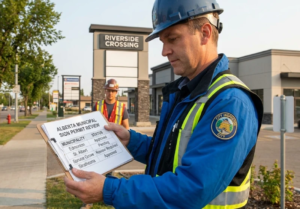
Most permanent exterior signs in St. Albert require a development permit from the City of St. Albert. That permit takes time, typically two to four weeks for a standard review, longer if your application needs revision or if the sign requires a variance. On top of permitting, production of a custom illuminated sign, channel letters, or monument sign typically takes two to four additional weeks from design approval. Add it up, and you’re looking at a six- to eight-week process minimum for a permitted, installed exterior sign.
Businesses that start this process when the lease is signed, not when the keys are handed over, open with proper signage on day one. Businesses that start two weeks before their target launch date are gambling on delays that the permit office won’t accommodate on their schedule.
The other practical reason to engage a St. Albert sign company early is design coordination. Signs should reflect your brand identity, and if that identity is still being finalized, your sign design process gives you a forcing function for making logo and color decisions that will carry across all your marketing materials. A sign company that offers design services can often assist with this broader brand development as part of the sign package.
Exterior Signage: The Signs That Make Your First Impression
Your exterior sign package will depend on your building type, lease terms, and the commercial corridor you’re located on. Here’s what to evaluate for each category.
Building-Mounted Signs (Fascia and Cabinet Signs)
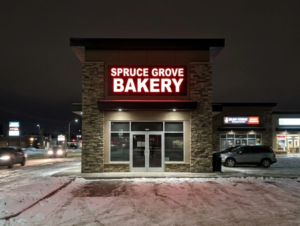
A building-mounted sign is the primary identification sign for most retail and commercial businesses in St. Albert. On corridors like St. Albert Trail, Boudreau Road, and Giroux Road, illuminated channel letters or cabinet signs are the standard, visible in the evening hours that matter for retail and food service businesses.
Channel letters are individually fabricated dimensional letters, typically lit from within with LED modules. They look premium, can be front-lit or halo-lit (where the light spills behind the letter against the building face), and are generally the most brand-consistent option for businesses with a strong logo or wordmark. Cabinet signs, a flat or internally illuminated box with a printed face, are more common for multi-tenant plazas where standardization is enforced by the property manager.
Your lease agreement will specify what types of signs are permitted on the building face. Review this with your sign company before investing in a design direction. Some landlords restrict non-standard sign types, require approval from property management, and maintain a sign criteria document that governs everything from font size to color palette.
Monument Signs and Freestanding Signs
If your business is in a standalone building, a strip mall with a shared monument sign, or a larger commercial development along St. Albert Trail, a monument sign or a freestanding identification sign may be relevant. Multi-tenant monument signs at the entrance of a plaza are typically managed by the property owner; your involvement is getting your business name panel produced and installed within the existing structure.
For businesses with their own freestanding sign opportunity, a monument sign at the property entrance provides visibility to drivers who may not be looking at your building face. St. Albert commercial developments on arterial roads often have monument sign setbacks that allow for good driver sightlines. A sign company familiar with the City of St. Albert’s sign bylaw can advise on what’s permitted at your specific address.
Window Graphics and Frosted Film
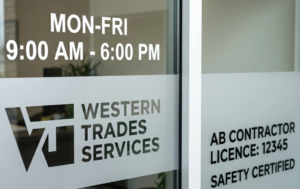
Window graphics do double duty: they communicate information (hours, services, contact) to people already approaching your door while also acting as partial privacy screening and branding for the storefront. For ground-level retail on pedestrian corridors in downtown St. Albert or Braeside commercial areas, window graphics are often the first brand impression someone gets before they even reach the building-mounted sign.
Frosted or etched-look window film on glass partitions or lower window sections is common for professional offices, healthcare practices, and financial services; it provides privacy without blocking all natural light. Printed vinyl graphics work for service menus, business hours, promotional messaging, and seasonal displays. Both are removable and replaceable, making them a lower-commitment option for businesses still refining their brand presentation in the first year of operation.
Interior Signage Checklist for New St. Albert Businesses
Interior signs are often left entirely off the pre-opening checklist, which means businesses open with bare walls and no wayfinding. That creates a poor first impression and a functional problem for customers who need to find the restrooms, the checkout, or the specific service department they came for.
Reception and Lobby Signs
For any business with a client-facing entrance, a lobby or reception sign is the single most important interior sign. This is your brand statement on the wall: a dimensional logo sign in acrylic, brushed metal letters, or a combination of materials that matches your brand aesthetic. It’s what clients photograph, what appears in your own marketing photos of the space, and what sets the tone for the experience that follows.
Custom signs St. Albert businesses use for reception areas range from simple flat-cut acrylic letters mounted directly on a painted wall to backlit or halo-lit metal logos on a feature wall. The scale should be proportional to the reception space; an 18-inch logo looks modest in a large waiting room; the same logo at 48 inches commands the space correctly. A sign company can advise on sizing relative to your wall dimensions.
Wayfinding and Directional Signs
Wayfinding signs guide visitors through your space without requiring staff intervention. At minimum, a new business needs directional signs to the restrooms, a sign identifying private or staff-only areas, and any directional signage appropriate to your layout, particularly if customers self-navigate to find products or service areas.
Alberta Building Code requirements apply here too. Businesses open to the public must provide accessible signage, tactile characters, and Braille on permanent rooms, including restrooms, stairwells, and exit doors. A St. Albert sign company experienced with commercial interior signage will be familiar with these requirements and can produce compliant signs as part of the interior package.
Wall Graphics and Environmental Branding
Beyond functional signage, wall graphics are one of the highest-impact ways to transform a commercial interior from a blank lease space into a branded environment. A brand values wall behind reception, a product photography wall in a retail space, or a mission statement graphic in a staff area all contribute to the sense that this business is established and intentional, not just occupying space temporarily.
Wall graphics are often budgeted separately from signage because they feel like decoration, but they belong in the pre-opening scope for the same reason: they’re part of what customers see and respond to in the first visit. An interior that looks branded from day one starts stronger than one that gets filled in over the first year.
Safety and Compliance Signs Every Alberta Business Needs
Compliance signage is not optional and not decorative. Every Alberta business open to the public has mandatory sign requirements under the Alberta Fire Code and the Alberta Building Code. These include fire exit route signs, emergency exit illumination, fire extinguisher location signs, and AED location markers where applicable.
Occupational health and safety signs are required in any workspace with employees: hazard identification, personal protective equipment requirements, and emergency contact posting are all regulated. For food service businesses, food safety notices and handwashing signs are required in specific locations under Alberta Health Services guidelines.
Getting these signs produced and installed before opening is not about aesthetics; it’s about passing your pre-opening inspections and operating without liability exposure from day one. A sign company that handles commercial interior signage regularly will have a standard suite of compliance signs available and will know which ones apply to your business type. Building this into your pre-opening package is the most efficient way to handle it.

Vehicle Graphics: Your Moving Business Sign in St. Albert
If your business operates service vehicles, a plumber, electrician, landscaper, or home services company serving St. Albert and the surrounding communities of Sturgeon County, vehicle graphics belong in your launch signage package. A wrapped or lettered truck driving through St. Albert’s neighborhoods generates impressions every time it’s on the road, parked at a job site, or sitting in your lot.
Custom signs St. Albert service businesses invest in most consistently include vehicle lettering and partial wraps, which put the business name, phone number, and service category on both sides and the rear of the vehicle. A clean, readable truck with your logo and contact information is your most cost-effective ongoing advertising, because it reaches homeowners exactly where they live, which is your customer base.
Full vehicle wraps are appropriate for businesses where visual branding is a strong differentiator (a creative agency, a specialty retailer, a food truck) or where fleet consistency across multiple vehicles matters for brand recognition. For most trades and service businesses, clear and readable partial graphics are the practical starting point.
Working with a St. Albert Sign Company: What to Expect
A full-service sign company handles your project from design through permit application, production, and installation. That end-to-end relationship simplifies your pre-opening workload significantly compared to sourcing design from one vendor, production from another, and installation from a third.
The sign consultation is where the project gets scoped. Bring your lease agreement (for building sign criteria), your logo files if you have them, and a clear sense of your timeline. The sign company will typically assess your location, discuss what the City of St. Albert permit process requires for your sign types, and provide a quote that covers everything from design through installation.
Business signage solutions St. Albert businesses rely on most are delivered by companies that know the local permit office, understand the specific corridors and commercial typologies of the city, and have done similar projects nearby. That local familiarity translates into fewer surprises in the permit process and faster resolution when questions arise.
FAQ
Q1: Do I need a permit for business signs in St. Albert?
Yes, most permanent exterior signs in St. Albert require a development permit from the City of St. Albert. This includes building-mounted signs, monument signs, and freestanding displays. Temporary signs such as real estate signs and construction site notices have different rules. Your sign company can assist with the permit application or advise on what documentation the city requires for your specific sign type.
Q2: How long does it take to get business signs made in St. Albert?
Production timelines vary by sign type. Basic printed signs and window graphics can be ready in two to five business days. Illuminated channel letters, cabinet signs, and custom dimensional signs typically take two to four weeks from design approval. Factor in the City of St. Albert permit review time on top of production if your signs require a permit; the full timeline from project start to installed sign is often six to eight weeks for permitted exterior signs.
Q3: What interior signs does a new business legally need in Alberta?
Alberta businesses open to the public are required to post specific safety signs, including fire exit routes and emergency contact information, under the Alberta Fire Code. Accessible signage with tactile characters and Braille is required in permanent rooms in publicly accessible buildings under the Alberta Building Code. Occupational health and safety postings are required in all employee workspaces. Your sign company can walk you through compliance requirements specific to your business type.
Q4: What is the most important sign a new business needs first?
Your exterior identification sign is the most critical because it establishes your location for customers and signals that you are open for business. If your space has a window or storefront, a high-quality window graphic can serve as interim signage while a permanent exterior sign is in production or awaiting a permit. This is a common and practical approach for businesses with tight opening timelines.
Q5: Can a St. Albert sign company handle design if I don’t have a logo?
Most full-service sign companies in St. Albert offer design services that include logo development or refinement as part of the sign package. If you already have brand guidelines or a logo file, share the vector files (AI or EPS format) to ensure clean, scalable output across all sign types. Bringing a complete brand package to the sign project typically reduces overall design time and ensures consistency across exterior signs, interior graphics, and vehicle branding.