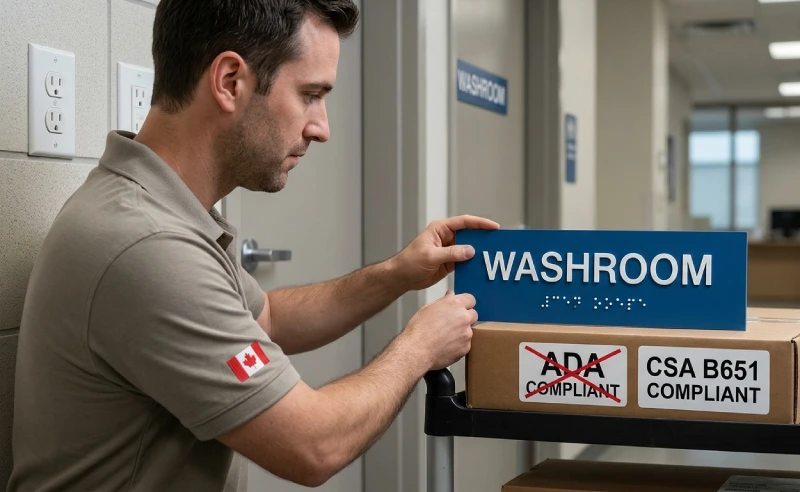
If a supplier is quoting you “ADA-compliant” signs for a building in Canada, they are citing the wrong law. The ADA, the Americans with Disabilities Act, is United States legislation. It has no legal force in Canada. That does not make accessible signage optional here. It means a different set of rules applies: the Accessible Canada Act, provincial accessibility laws, provincial building codes, and the technical standard CSA B651. The physical sign is often identical, raised characters and Grade 2 Braille with proper contrast, but the label on the invoice matters the day a building inspector or a lawyer asks which code you actually met.
| Key takeaways
• ADA is United States law and does not apply to buildings in Canada. • Accessible signs in Canada are governed by the Accessible Canada Act, provincial accessibility laws, provincial building codes, and CSA B651. • In Alberta, the requirements live in the National Building Code 2023 Alberta Edition (barrier-free provisions) together with CSA B651. • The sign you actually need tactile characters, Grade 2 Braille, and correct contrast. Order it by specification, not by the ADA label. |
What this guide covers
- Does the ADA apply in Canada, and why the term is everywhere
- The Canadian framework that actually governs your signs
- Accessibility signage rules in Alberta and Edmonton
- What an accessible sign actually needs (the spec checklist)
- How to order accessible signs in Canada without getting the law wrong
- Frequently asked questions
Does the ADA apply in Canada?
No. The Americans with Disabilities Act is a US federal law passed in 1990. Its sign requirements come from the 2010 ADA Standards for Accessible Design, which set the familiar specs for tactile characters, Grade 2 Braille, non-glare finishes, contrast, and mounting height. Those standards govern buildings in the United States. They carry no legal weight north of the border.
So why is the phrase “ADA signs” all over Canadian search results and sign-shop websites? Because the term traveled with the product. Most architectural and accessibility signage sold in North America was designed against the ADA spec, catalogues use ADA part numbers, and buyers picked up the vocabulary. The word became a shorthand for “the Braille-and-tactile signs by the door,” even in a country the ADA never touched. The demand is real. The label is just borrowed from the wrong statute.
The Canadian framework that actually governs your signs
Accessibility in Canada is not one law; it is a stack of them. Four layers matter for signage.
-
The Accessible Canada Act (federal)
The Accessible Canada Act (S.C. 2019, c. 10) came into force in 2019 with the stated goal of a barrier-free Canada by 2040. It applies to organizations under federal jurisdiction: banks, airlines, telecommunications, interprovincial transport, and the federal government itself. It sets the direction rather than the millimetre-level sign specs, but it is the federal backbone that the closer rules hang from. If your business is federally regulated, this act is directly in scope.
-
Provincial accessibility laws
Most people who ask for “the Canadian ADA” are really asking about a provincial accessibility act. Several provinces have one. Ontario passed the Accessibility for Ontarians with Disabilities Act (AODA) in 2005, the best known of the group. Manitoba, Nova Scotia, British Columbia, Newfoundland and Labrador, and Saskatchewan have each since enacted their own accessibility legislation. These acts set standards, timelines, and reporting duties for organizations in that province.
Alberta is the exception that matters for this article: it has no standalone provincial accessibility act of the AODA type. That does not mean Alberta has no rules. It means the accessibility requirements for signage sit in the building code instead, which is the next layer.
-
Provincial building codes
For most private businesses, this is the layer that actually bites. Each province adopts a building code with barrier-free design provisions, and those provisions are what a plan reviewer or inspector checks on a new build or a renovation. Building codes are where accessible signage stops being a good idea and becomes a condition of occupancy.
-
CSA B651, the technical standard
CSA B651, “Accessible design for the built environment,” is the Canadian technical standard that specifies the physical details: tactile character height and style, Grade 2 Braille, colour contrast, and placement. Designers, architects, and building codes across Canada reference it the way US specifiers reference the ADA Standards. When a Canadian sign is described as “accessible,” CSA B651 is usually the yardstick behind that word. This is the standard to name on a Canadian project, not the ADA.
Accessibility signage rules in Alberta and Edmonton
For a business in Edmonton or anywhere in Alberta, the answer is concrete. Two documents govern your accessible signs.
- The National Building Code 2023 Alberta Edition, which took effect May 1, 2024. Its barrier-free design requirements are the code layer a plan reviewer applies to your space.
- CSA B651, which supplies the technical specifications for tactile lettering, Grade 2 Braille, and contrast that the code and Alberta designers rely on.
Because Alberta has no separate accessibility act, there is no second provincial statute layered on top the way there would be in Ontario. That actually simplifies the picture: get the building-code barrier-free provisions and CSA B651 right, and your signage is on solid ground. In Edmonton, new or altered signage may also need a permit, which is a separate approval from the accessibility question but often lands on the same project timeline.
In our experience, the confusion almost always shows up at the quoting stage. A supplier prices “ADA signs,” the client assumes that phrase means “legal in Alberta,” and nobody checks whether the sign was actually built to CSA B651. The characters and Braille are frequently fine. The paperwork and the claim are what fail. Sorting out permits and code sign-off early, ideally alongside your sign permit and application step, keeps that mismatch from surfacing after installation.
What an accessible sign actually needs (the spec checklist)
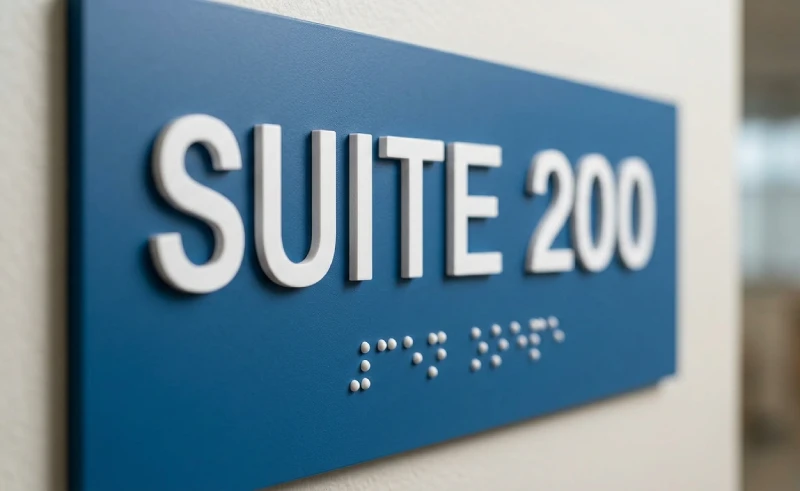
Here is the useful part, and it is why the ADA label persists: the physical sign is largely the same object on both sides of the border. An accessible room, washroom, or exit sign in Canada generally needs the following. Treat this as an orientation list and confirm the exact figures against the current CSA B651 edition and your building code, since dimensions and mounting heights are set there.
- Tactile lettering: Raised (tactile) characters, usually a clean sans-serif, so they can be read by touch as well as sight.
- Grade 2 Braille: Contracted Braille positioned below the tactile text, the standard for permanent room and facility identification.
- High visual contrast: Big difference in light reflectance between characters and background, light on dark or dark on light, so low-vision readers can distinguish them.
- Non-glare finish: A matte or eggshell surface so glare does not wash out the text under building lighting.
- Correct mounting and placement: Beside the latch side of the door, at a consistent height, so a user can find and touch it predictably.
- Pictograms where required: Standard symbols for washrooms, accessibility, and exits where the code calls for them.
If you are outfitting a whole floor, these details need to stay consistent across every accessible interior sign that meets CSA B651, from suite plates to wayfinding. Mixed contrast or inconsistent mounting across a building is one of the most common reasons an otherwise fine sign package fails a review.
How to order accessible signs in Canada without getting the law wrong
You do not need to argue statutes with a supplier. You need to ask for the sign by specification and confirm the standard behind it. Four questions do the job.
- Which standard is this built to? If the answer is “ADA,” that is a flag to dig further, because ADA is US law. The correct answer for a Canadian project is CSA B651 and the applicable building code.
- Does it include tactile lettering and Grade 2 Braille? Grade 2 Braille and raised characters are the baseline for permanent room and facility signs. Ask to see it named on the quote.
- What is the contrast and mounting spec? A supplier who works to CSA B651 will answer without hesitating. Consistent contrast and mounting across the building is what a reviewer checks.
- Are permits and code approval handled? On a new build or renovation, accessibility sign-off and any sign permit belong on the project schedule from the start, not after the signs are on the wall.
For most interiors, the pieces that carry accessibility duties are the room identification and suite signs and the directional and wayfinding signage that moves people through the space. Those are the elements to spec carefully to CSA B651. And because a sign only stays compliant while it stays legible, factor in sign maintenance and repair so contrast and tactile surfaces are not degraded years later. If you want the wider context on planning an interior sign program, the complete guide to interior signs for Edmonton businesses walks through the full system.
Frequently asked questions
- Does the ADA apply in Canada? – No. The Americans with Disabilities Act is US federal law and has no legal force in Canada. Canadian accessible signage is governed by the Accessible Canada Act, provincial accessibility laws, provincial building codes, and the technical standard CSA B651.
- What is the Canadian equivalent of the ADA? – There is no single equivalent. Federally, the Accessible Canada Act (2019) sets the barrier-free goal. Provincially, several provinces have their own accessibility acts, such as Ontario’s AODA. For the physical sign specifications, CSA B651 is the standard designers and codes reference.
- Are Braille and tactile signs required by law in Canada? – Yes, in the situations the building code covers. Permanent room and facility identification signs generally must carry raised tactile characters and Grade 2 Braille with adequate contrast. The exact triggers and dimensions come from your provincial building code and CSA B651.
- What accessibility sign rules apply in Alberta and Edmonton? – Alberta has no standalone accessibility act, so the requirements sit in the National Building Code 2023 Alberta Edition (barrier-free provisions), which took effect May 1, 2024, together with CSA B651. Edmonton projects may also need a sign permit, which is a separate approval.
- What is CSA B651? – CSA B651, Accessible design for the built environment, is the Canadian technical standard that specifies tactile character height and style, Grade 2 Braille, colour contrast, and placement for accessible signage. It is the Canadian counterpart to the US ADA Standards.
- Do I need ADA signs for my business in Canada? – You need accessible signs, and you should not order them under the ADA label. Ask for signs built to CSA B651 and your building code. The finished product, tactile characters and Grade 2 Braille with proper contrast, is what US buyers call ADA signs, but the correct Canadian reference is CSA B651.
The bottom line
Accessible signage in Canada is not governed by the ADA, and any page or supplier that says otherwise is quoting the wrong country’s law. The rules that apply are the Accessible Canada Act, provincial accessibility legislation, provincial building codes, and CSA B651. In Alberta, that means the National Building Code 2023 Alberta Edition and CSA B651. The good news for buyers is that the sign itself rarely changes. Order it by specification, name CSA B651, and the label stops mattering.
Planning accessible signage for a space in Edmonton or across Alberta? Pivotal builds tactile and Braille signage to CSA B651, from single room plates to full accessible interior sign programs. Ask for the standard by name and get it done right the first time.