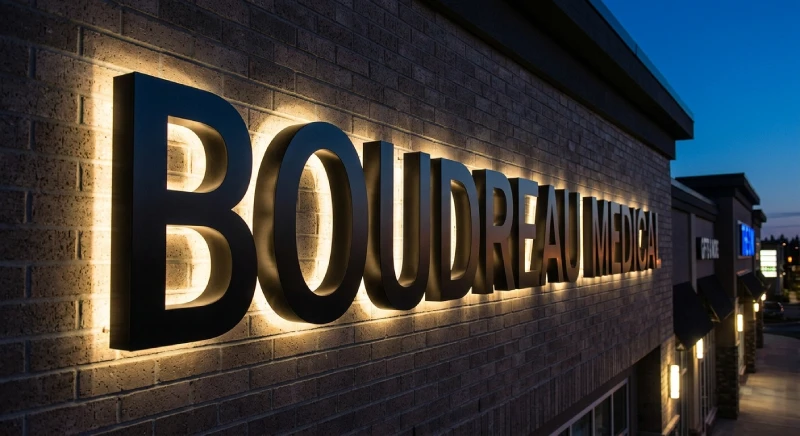
St. Albert’s commercial corridors (St. Albert Trail, Boudreau Road, Grandin Road, and the newer commercial nodes near Ray Gibbon Drive) are active well into evening hours. Dental clinics on Boudreau run evening appointments. Gyms and fitness studios have their busiest hours at 6 and 7 PM. Restaurants fill for dinner service. Retailers stay open until 9 PM through the fall and holiday season. For all of these businesses, a sign that cannot be seen after dark is a sign that is not working for a large part of the business day.
Alberta’s latitude makes this more acute than it would be in milder markets. In St. Albert, sunset in late December falls before 4:30 PM. For six months of the year, the majority of evening customer activity happens in darkness. An unilluminated sign in a corridor where competitors have illuminated signs communicates one thing clearly: that you are not open, not active, not present. Whether that message is accurate or not, it is the message that gets sent.
This guide covers the illuminated sign options for St. Albert businesses: LED channel letters, backlit cabinet signs, and the broader illuminated sign category. It also addresses the energy cost reality and the specific permit requirements that apply to illuminated signs in St. Albert.
The Evening Economy in St. Albert: Why Illumination Is a Business Decision
Calculate the hours per year when a St. Albert business sign needs to work in darkness. From the end of October through the beginning of March, sunset comes before 5 PM; that is roughly 120 days when any customer arriving at your business after 5 PM arrives in darkness. Add the transition shoulder seasons (September-October and March-April) when sunset comes between 5 and 7 PM, and a business open until 8 or 9 PM is competing in darkness for most of its open hours on most evenings for six months of the year.
In the specific commercial context of St. Albert Trail, businesses with illuminated signs are visible from the road at night; businesses without them are not. For a retailer competing against adjacent tenants for the attention of drivers on St. Albert Trail after 5 PM, the illuminated sign is not a differentiator, but table stakes. The differentiator is the quality and character of that illumination.
The decision to invest in an illuminated sign is a revenue decision. An evening customer base that can see and identify your business generates revenue. One that cannot see your sign after dark does not, regardless of whether you are technically open.
LED Channel Letters St. Albert: Best in Class for Storefronts
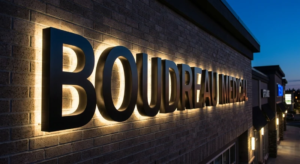
LED channel letters are the premium standard for St. Albert storefront illuminated signs, combining the dimensional brand presence of individual letter forms with the visibility of internal LED illumination. They are individually fabricated, custom-made to your business name and logo in the specific type style and color of your brand, and mounted directly on the building face, not on a raceway or a cabinet, directly on the building surface.
Front-lit channel letters are the most common configuration in St. Albert’s commercial corridors. The LED modules illuminate the interior of the letter channel, and the light projects through a translucent acrylic face. At night, each letter glows uniformly. During daylight hours, the dimensional aluminum letter form with its depth and painted returns reads as a solid, professional sign. This format is what most franchise retailers use, which means an independent business using quality channel letters is competing visually at the same level as any chain on the corridor.
Halo-lit channel letters are increasingly popular in St. Albert’s newer commercial developments and in the premium retail and professional services contexts on Boudreau Road and around the St. Albert Centre. The aesthetic is sophisticated: a warm or cool halo around each letter rather than a glowing face. For businesses where brand refinement matters as much as raw visibility, halo-lit letters are the appropriate choice.
The City of St. Albert sign permit requirements for channel letters include a development permit from Planning and Development Services and a separate electrical permit for the illumination. The heritage overlay area around Perron Street in the downtown has additional considerations: not all illuminated sign formats are compatible with the heritage guidelines, and the design review process for Perron Street properties adds time to the permit sequence. A sign company with St. Albert experience navigates this correctly from the design stage.
Backlit Cabinet Signs: Reliable, Cost-Effective Illumination
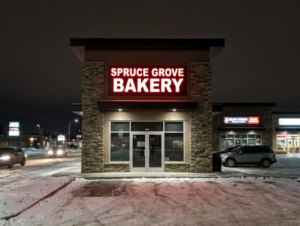
Cabinet signs are the most common illuminated sign format in St. Albert’s commercial plazas, primarily because many plaza properties have existing sign bands or specified sign formats that favour this configuration. The property management specifies a sign cabinet size, and tenants produce illuminated faces to fit the existing hardware. This standardization has practical advantages for tenants: the infrastructure is in place, the electrical connection exists, and the process is primarily about producing a new face graphic rather than a full sign installation.
For businesses starting from scratch, modern slim-profile LED cabinet signs are a considerably better product than the older fluorescent-lit boxes they have replaced. Even light distribution across the full face, significantly lower energy consumption, and LED module lifespans measured in years rather than months make modern LED cabinets a reliable and low-maintenance illuminated sign. For a business that wants effective night-time visibility without the investment of channel letters, a well-designed LED cabinet sign with a strong graphic is a completely appropriate solution.
Cold-temperature performance matters for outdoor cabinet signs in St. Albert. Polycarbonate faces are the correct specification for Alberta outdoor cabinet signs; they remain impact-resistant at temperatures well below -30°C, where standard acrylic becomes increasingly brittle and vulnerable to cracking from minor impacts. Any St. Albert sign company specifying an outdoor cabinet sign should use polycarbonate as the standard face material, not acrylic. If a quote specifies acrylic on an outdoor sign, it is worth asking why.
Energy-Smart LED Signs: Understanding Operating Costs
LED illuminated signs are considerably more energy-efficient than the neon and fluorescent signs they have replaced, and the efficiency difference translates to meaningful operating cost savings over the lifespan of the sign.
A rough comparison for a typical retail storefront sign running 12 hours per day, 365 days per year in St. Albert: a set of neon channel letters in the 20-foot range consumes approximately 200 to 300 watts continuously. Equivalent LED channel letters consume 40 to 80 watts for the same visual output, roughly a 70 to 80 percent reduction in electricity consumption. At Alberta’s commercial electricity rates, this represents a saving of $150 to $250 per year on sign electricity alone. Over a 10-year sign lifespan, the energy savings typically exceed $1,500, which is a meaningful offset against the purchase cost.
The maintenance cost difference is equally significant. Neon signs require periodic recharging of the gas tubes as the luminous output degrades, and neon tubes can fail suddenly, leaving the sign dark. LED modules in channel letters and cabinet signs are rated for 50,000 or more hours; at 12 hours per day, that is 11 years of continuous operation before output begins to degrade measurably. LED signs run for years without maintenance intervention, while equivalent neon signs require tube service every three to five years at minimum.
St. Albert has a general sustainability orientation in its municipal planning, and some commercial properties in newer developments have sustainability reporting requirements or tenant engagement programs where LED sign energy efficiency can be documented. For businesses in these properties, an LED sign certificate or specification sheet confirming the energy consumption of the installed sign may be relevant documentation.
St. Albert Sign Permit Requirements for Illuminated Signs
Illuminated signs in St. Albert require two permits: a development permit from the City of St. Albert Planning and Development Services, and an electrical permit from the electrical safety authority for the illumination components. These are parallel processes that can run simultaneously once the sign design is finalized, but both must be in hand before the sign is installed and energized.
The development permit application for an illuminated sign includes dimensioned drawings of the sign with specified dimensions, mounting method, height above grade, and sign area calculation relative to the bylaw’s permitted area formula. For illuminated signs adjacent to residential zones, the bylaw may impose additional requirements around illumination brightness and light direction to prevent spill onto neighboring residential properties. Confirm these requirements with Planning and Development before finalizing the sign design.
The Perron Street heritage area has specific sign design guidelines that affect illuminated sign types. Front-lit channel letters and halo-lit letters in restrained colors are generally compatible with the heritage guidelines. Illuminated cabinet signs, particularly back-lit internally-lit box signs with translucent faces, may be subject to design review depending on the specific property. Electronic message centres are not permitted in most heritage overlay areas in St. Albert. A sign company with direct experience in the Perron Street permit process is the right partner for a heritage area project.
FAQ
- What illuminated sign is best for a St. Albert business? – For most St. Albert retail and service businesses on major corridors like St. Albert Trail and Boudreau Road, LED channel letters offer the best combination of visibility, brand quality, and long-term operating efficiency. Front-lit channel letters provide the highest raw visibility; halo-lit letters offer a more architectural aesthetic suitable for professional services and upscale retail. For businesses where budget is the primary constraint, a well-designed LED cabinet sign provides reliable full night-time visibility at a lower investment than channel letters.
- How much do LED signs cost in St. Albert? – LED channel letter signs for a typical St. Albert retail storefront range from approximately $3,500 to $9,000 installed, depending on letter count, size, illumination type, and mounting complexity. Internally illuminated cabinet signs start around $2,500 to $5,000 for a standard retail application. Halo-lit dimensional metal letters are generally at the higher end of the channel letter range. All ranges include design, permit application, production, and installation. A site visit is required for accurate pricing on any specific installation.
- Are LED signs allowed on Perron Street in St. Albert? – Perron Street falls within St. Albert’s downtown heritage overlay area, which has design guidelines that apply to exterior signs in addition to the standard sign bylaw. Front-lit and halo-lit channel letters in restrained colors are generally compatible with the heritage guidelines. Internally illuminated box cabinet signs and electronic message centres may not be permitted or may require additional design review under the heritage overlay. Confirm with the City of St. Albert’s Planning and Development office or work with a sign company experienced in the Perron Street heritage review process before committing to a design direction.
- How long do LED signs last in Alberta’s climate? – LED illumination modules in channel letters and cabinet signs are rated for 50,000 or more hours of operation. At 12 hours per day, over 11 years before output begins to degrade measurably. The LED modules themselves rarely fail before the physical sign housing. In Alberta’s climate, the sign housing is typically the component that requires attention after 8 to 12 years, not the LED source. Polycarbonate faces, which handle Alberta cold temperatures significantly better than acrylic, extend the housing lifespan.
- Can I upgrade an existing fluorescent cabinet sign to LED in St. Albert? – Yes, in most cases. Existing fluorescent-lit cabinet signs can be retrofitted with LED modules, reducing energy consumption by 50 to 80 percent and eliminating the cost of fluorescent tube replacement. The retrofit requires a licensed Alberta electrician and should be coordinated through your sign company. An electrical permit is required for the retrofit work. If the existing cabinet housing is in good condition, an LED retrofit is typically more cost-effective than a full sign replacement; the break-even on energy savings alone is often 2 to 3 years.